
Learn about Socially Responsible Investing
Contact Frankly Financial for Retirement and Insurance Planning Assistance


It isn't how much you make
. . .It's how much you keep!

  • Home
  • About
  • Financial Planning
    • Overcoming Retirement Challenges
    • IRA Roll-Over Benefits
    • Saving for College Takes Careful Planning
  • Insurance
    • Guaranteed Investment Stream
    • Long-Term Health Care Insurance
  • Contact Frank

Archive for Blog – Page 11

For College Savings, 529 Plans Are Hard to Beat

Posted by Frank McKinley on
 December 2, 2019

Raising kids is hard enough, so why not make things easier for yourself when it comes to saving for college? Ideally, you want a savings vehicle that doesn’t impose arbitrary income limits on eligibility; lets you contribute a little or a lot, depending on what else happens to be going on financially in your life at the moment; lets you set up automatic, recurring contributions from your checking account so you can put your savings effort on autopilot; and offers the potential to stay ahead of college inflation, which has been averaging 3% to 4% per year.1 Oh, and some tax benefits would be really nice, too, so all your available dollars can go to college and not Uncle Sam. Can you find all of these things in one college savings option? Yes, you can: in a 529 plan.

Benefits

529 college savings plans offer a unique combination of features that are hard to beat when it comes to saving for college, so it’s no surprise why assets in these plans have grown steadily since their creation over 20 years ago.

Eligibility. People of all income levels can contribute to a 529 plan — there are no restrictions based on income (unlike Coverdell accounts, U.S. savings bonds, and Roth IRAs).

Ease of opening and managing account. It’s relatively easy to open a 529 account, set up automatic monthly contributions, and manage your account online. For example, you can increase or decrease the amount and frequency of your contributions (e.g., monthly, quarterly), change the beneficiary, change your investment options, and track your investment returns and overall progress online with the click of a mouse.

Contributions. 529 plans have high lifetime contribution limits, generally $350,000 and up. (529 plans are offered by individual states, and the exact limit depends on the state.) Also, 529 plans offer a unique gifting feature that allows lump-sum gifts up to five times the annual gift tax exclusion — in 2020, this amount is up to $75,000 for individual gifts and up to $150,000 for joint gifts — with the potential to avoid gift tax if certain requirements are met. This can be a very useful estate planning tool for grandparents who want to help pay for their grandchildren’s college education in a tax-efficient manner.

Tax benefits. The main benefit of 529 plans is the tax treatment of contributions. First, as you save money in a 529 college savings plan (hopefully every month!), any earnings are tax deferred, which means you don’t pay taxes on the earnings each year as you would with a regular investment account. Then, at college time, any funds used to pay the beneficiary’s qualified education expenses — including tuition, fees, room, board, books, and a computer — are completely tax-free at the federal level. This means every dollar is available for college. States generally follow this tax treatment, and many states also offer an income tax deduction for 529 plan contributions.

Drawbacks

But 529 plans have some potential drawbacks.

Tax implications for funds not used for qualified expenses. If you use 529 plans funds for any reason other than the beneficiary’s qualified education expenses, earnings are subject to income tax (at your rate) and a 10% federal penalty tax.

Restricted ability to change investment options on existing contributions. When you open a 529 college savings plan account, you’re limited to the investment options offered by the plan. Most plans offer a range of static and age-based portfolios (where the underlying investments automatically become more conservative as the beneficiary gets closer to college) with different levels of risk, fees, and management objectives. If you’re unhappy with the market performance of the option(s) you’ve chosen, you can generally change the investment options for your future contributions at any time. But under federal law, you can change the options for your existing contributions only twice per year. This rule may restrict your ability to respond to changing market conditions, so you’ll need to consider any investment changes carefully.

Getting started

529 college savings plans are offered by individual states (but managed by financial institutions selected by the state), and you can join any state’s plan. To open an account, select a plan and complete an application, where you will name an account owner (typically a parent or grandparent) and beneficiary (there can be only one); choose your investment options; and set up automatic contributions if you choose. You are then ready to go. It’s common to open an account with your own state’s 529 plan, but there may be reasons to consider another state’s plan; for example, the reputation of the financial institution managing the plan, the plan’s investment options, historical investment performance, fees, customer service, website usability, and so on. You can research state plans at the College Savings Plans Network.

1 College Board, Trends in College Pricing, 2014-2018

 

Categories : Blog, College Savings, Financial Services

Long-Term Care Insurance – Facts and Tips

Posted by Frank McKinley on
 September 5, 2019

Long term care is extended care that consists of help with activities of daily living (such as dressing and bathing), and/or care needed due to severe cognitive impairment (such as the dysfunction caused by Alzheimer’s disease).   This care can be received at home or at a facility such as an assisted living facility or a nursing home.  This care can be very expensive, and is a great threat to financial security in retirement.

By reading the information in this brochure and then talking with Frank you are taking important steps to preserve your quality of life and your financial future — and your family’s — regardless of what the future may hold.

Frank McKinley can help weed through the fine print
and help you get the right long-term care insurance coverage.

Long-Term Care Insurance Guide provides valuable information


Categories : Blog, Insurance, Long-term Care

Don’t you LOVE Robocalls?

Posted by Frank McKinley on
 June 10, 2019

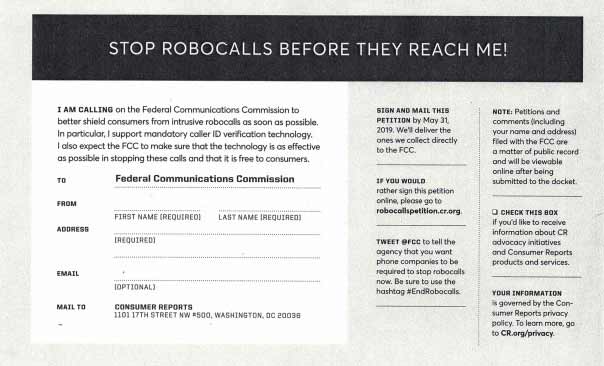
Have you noticed the incredible increase in Robocalls lately? Well the publishers of CONSUMER REPORTS have and are offering a reason for the INCREASE and a way to help stop them In the May edition. Get a copy on a local newsstand or read it in the library and copy the petition to the FCC (below) and SEND IT IN or use one of the other 6 methods to express yourself.

Sign the petition to stop robocalls


Categories : Blog, Financial Services

ANYONE can have an IRA for 2017!

Posted by Frank McKinley on
 March 19, 2018

As long as you have earned income and are not receiving RMDs, you can fund an IRA EVEN if you contribute to a company retirement plan.

You just need to use the right kind of account and perhaps file an additional IRS form when you make the contribution so the money can come out TAX-FREE in retirement. Sound good?

Then give me a call TODAY to learn how it can be done
— as tax filing day approaches rapidly!

You have until your tax return due date (not including extensions) to contribute up to $5,500 for 2017 ($6,500 if you were age 50 by December 31, 2017). For most taxpayers, the contribution deadline for 2017 is April 17, 2018.

There’s still time to make a regular IRA contribution for 2017! You have until your tax return due date (not including extensions) to contribute up to $5,500 for 2017 ($6,500 if you were age 50 by December 31, 2017). For most taxpayers, the contribution deadline for 2017 is April 17, 2018.

You can contribute to a traditional IRA, a Roth IRA, or both, as long as your total contributions don’t exceed the annual limit (or, if less, 100% of your earned income). You may also be able to contribute to an IRA for your spouse for 2017, even if your spouse didn’t have any 2017 income.

Traditional IRA

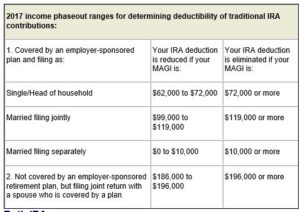
You can contribute to a traditional IRA for 2017 if you had taxable compensation and you were not age 70½ by December 31, 2017. However, if you or your spouse was covered by an employer-sponsored retirement plan in 2017, then your ability to deduct your contributions may be limited or eliminated depending on your filing status and your modified adjusted gross income (MAGI) (see table below). Even if you can’t deduct your traditional IRA contribution, you can always make nondeductible (after-tax) contributions to a traditional IRA, regardless of your income level. However, in most cases, if you’re eligible, you’ll be better off contributing to a Roth IRA instead of making nondeductible contributions to a traditional IRA.


Roth IRA

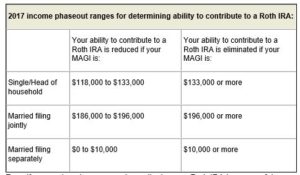
You can contribute to a Roth IRA if your MAGI is within certain dollar limits (even if you’re 70½ or older). For 2017, if you file your federal tax return as single or head of household, you can make a full Roth contribution if your income is $118,000 or less. Your maximum contribution is phased out if your income is between $118,000 and $133,000, and you can’t contribute at all if your income is $133,000 or more. Similarly, if you’re married and file a joint federal tax return, you can make a full Roth contribution if your income is $186,000 or less. Your contribution is phased out if your income is between $186,000 and $196,000, and you can’t contribute at all if your income is $196,000 or more. And if you’re married filing separately, your contribution phases out with any income over $0, and you can’t contribute at all if your income is $10,000 or more.

2017 income phaseout rnges
Even if you can’t make an annual contribution to a Roth IRA because of the income limits, there’s an easy workaround. If you haven’t yet reached age 70½, you can simply make a nondeductible contribution to a traditional IRA, and then immediately convert that traditional IRA to a Roth IRA. Keep in mind, however, that you’ll need to aggregate all traditional IRAs and SEP/SIMPLE IRAs you own — other than IRAs you’ve inherited — when you calculate the taxable portion of your conversion. (This is sometimes called a “back-door” Roth IRA.)

Finally, keep in mind that if you make a contribution to a Roth IRA for 2017 — no matter how small — by your tax return due date, and this is your first Roth IRA contribution, your five-year holding period for identifying qualified distributions from all your Roth IRAs (other than inherited accounts) will start on January 1, 2017.

Want more information or need clarification?
Then give me a call TODAY?

Categories : Blog, Financial Services, Investing, IRA, ROTH

Don’t Take It From Me

Posted by Frank McKinley on
 January 23, 2018
Dont take it from me - 2018-01-02 Newsletter
Categories : Blog, Financial Services, Investing, Investments, IRA

A Rollover IRA or Your Former Employer’s Retirement Plan

Posted by Frank McKinley on
 October 31, 2017

Let’s say you’re leaving one job and (hopefully) headed to another.  Or you left retirement plan assets with a previous employer.

To Roll or Not to Roll (Over) Your Former Employer’s Retirement Plan?

Should you leave your retirement assets behind or move them to a new custodian?  Did you know that both the custodian and your former employer can share in the fees?

Frank McKinley, a licensed Financial Advisor, can assist you in deciding if a rollover IRA right for you.What are the benefits of either course of action?  If you do neither and simply ‘cash out’, what are the tax implications?

If left behind there’s a chance the company may be acquired, merged or just go out of business.  Then what?  How will you access your money?  How will you even find the company and get your money?

What if you move and they lose track of you due to returned mail or invalid email addresses?  How will they (eventually) track you down?  Or how will you find them?  Isn’t there a central source for information like this?

Would you like to have more investment choices than may be available where the money is now or in your new employer’s plan?  Would you prefer more diversity?

The Rollover IRA and Tax and Inheritance Considerations

Do you want to streamline passage of those assets to your heirs and beneficiaries by consolidating retirement accounts currently in more than one place?

Are you thinking of retiring before age 55 and perhaps tapping your retirement savings?

Does combining the inherent tax-deferral with living benefits such as guaranteed annual increases or guaranteed annual payouts when distributions start interest you? (Guarantees dependent on the claims-paying ability of the issuing carrier).

Do you want to decide which investments to draw from for your RMDs?

If you identify with even one of the questions above, you may benefit from a Rollover IRA.

Please contact Frank McKinley TODAY to discuss whether a Rollover IRA may be right for you.

Categories : Blog, Financial Services, Investing, IRA, Retirement, ROTH, Tax
← Previous Page
Next Page →

Recent Newsletters & Blogs

  • And you think you have it bad…
  • Winter, BRRR…
  • U.S. Elections Spark Global Financial Uncertainty
  • THE ELECTION IS HEATING UP!
  • 3 Mistakes Investors Make During Election Years

Archives


Categories

  • 529 Savings Plans
  • Blog
  • Bonds
  • College Savings
  • Contributions
  • Credit Card Debt
  • estate planning
  • financial planning
  • Financial Services
  • Insurance
  • Investing
  • Investments
  • IRA
  • Life Insurance
  • Long-term Care
  • Medicaid
  • Medicare
  • Newsletters
  • Paycheck Protection Program
  • rebate payments
  • Retirement
  • ROTH
  • Savings
  • Savings Goals
  • Security
  • Social Security
  • socially responsible investing
  • Stocks
  • Tax
  • The CARES Act
  • the SECURE ACT
  • unemployment benefits
  • Wills
Frankly Financial | Copyright © 2014. All Rights Reserved.
Site Designed by TriDelta Design Group