

Learn about Socially Responsible Investing
Contact Frankly Financial for Retirement and Insurance Planning Assistance


It isn't how much you make
. . .It's how much you keep!

  • Home
  • About
  • Financial Planning
    • Overcoming Retirement Challenges
    • IRA Roll-Over Benefits
    • Saving for College Takes Careful Planning
  • Insurance
    • Guaranteed Investment Stream
    • Long-Term Health Care Insurance
  • Contact Frank

Archive for Blog – Page 9

So What CAN We Do?

Posted by Frank McKinley on
 April 20, 2020

Be prepared for a bear market

“There are decades where nothing happens; and there are weeks when decades happen.”-Vladimir Lenin

“The last leg of a bull market always ends in hysteria; the last leg of a bear market always ends in panic.” – Jim  Rogers

We are all aware of the pandemic but…do you remember the previous 14 over the last 40 years? Probably not. We recovered from them and we’ll recover from this.

But what CAN we DO?

  • Minimize contact with groups; work & do schoolwork online.
  • Go for walks, read a good book or The Good Book.
  • Watch a favorite movie, VHS, DVD or online.
  • If you play an instrument- practice. If you don’t, listen to music as it soothes the savage beast.
  • Work on your taxes (returns may have been extended to July 15, but payment is still due April 15).
  • If you’re eligible and haven’t made any ‘19 or ‘20 IRA contributions, consider doing so now.
  • If possible, invest cash in a brokerage account and ‘buy low’.
  • Take advantage of the warmer weather and start a vegetable garden.
  • Don’t watch any more ‘news’ than usual- it’s not going to be real good for a while.

And PLEASE contact me with any concerns!

Categories : Blog, Financial Services

Bear Markets Happen

Posted by Frank McKinley on
 April 15, 2020
At least annually, you should review your portfolio’s performance, comparing it to relevant benchmarks and determining whether you are making progress toward accomplishing your financial goals. Consider these steps in the process:
  • Measure the performance of each investment in your portfolio. Many investments and investment managers will provide you with periodic performance information.
When reviewing this information, keep in mind the following points:
  • Often, an investment’s return is reported on a time-weighted basis, which does not consider when you invested.
  • Information that reports your portfolio’s return is generally expressed on a dollar-weighted basis, which measures the investment return based on when cash inflows and out-flows occurred. While this is a more relevant measure when evaluating your portfolio, time-weighted returns can make it easier to compare the returns of different investments.
  • Investments often report cumu-lative annualized returns over a period of time, representing the aver-age annual performance over that

Continued on page 2

Frankly Speaking

Bear Markets HAPPEN!

The Black Death killed 20 million Europeans in the 14th century. Venice, a major trade port, grew nervous. If a ship was suspected of harboring the plague, it had to wait 40 days before any passengers or goods could come ashore. Venice built a quarantine center on an island off its coast, where sailors from plague-infested ships were sent either to get better or, more likely, to die. This 40-day waiting period became known as quarantinario, from the Italian word for 40. – –  NPR January 26, 2020

“The shortest period of time known to mankind is the time between when it is too soon to buy stocks and when it is too late.” – Mark Zinder

“Never let a good crisis go to waste.” – Winston Churchill

You may notice slight differences in this edition of Financial Success from my old newsletter. The latter was relatively generic while the former includes financial planning topics, from establishing goals and following economic trends to retirement, estate and tax planning, insurance and investments. A longer ‘sidebar’ will appear in the hard copy version and as an introduction to the HTML version. If you would like to see specific topics addressed, please let me know.

By now the Covid-19 or Wuhan virus has become as much a part of daily life as was the 10+ year stock market bull run in January. Did we really think it would last forever; that trees grew to the sky or that we had become so brilliant as to be impervious to the inevitability of periodic setbacks? Question is — did you re-balance your portfolio, shift some high performers to more conservative, fixed income-oriented positions or ‘guaranteed lifetime income accounts’*? Or has this ‘Black Swan’ event caught you entirely by surprise?

You may think there is no ‘getting back’ what you feel are losses, but if you haven’t sold or cashed out for CDs (Certificates of Depreciation), which offer less than the current rate of inflation.

PLEASE call or email me for a FREE no-cost, no-obligation consultation to see what we can do to improve your situation and create a brighter financial future for you and your family.

Click here to read the full article

*Based on the claims paying ability of the issuing company

Copyright © 2020. Some articles in this newsletter were prepared by Integrated Concepts, a separate, nonaffiliated business entity. This newsletter intends to offer factual and up-to-date information on the subjects discussed but should not be regarded as a complete analysis of these subjects. Professional advisers should be consulted before implementing any options presented. No party assumes liability for any loss or damage resulting from errors or omissions or reliance on or use of this material.

Categories : Blog, Financial Services

Some Short-Term Advice

Posted by Frank McKinley on
 April 15, 2020

First, let me thank all medical professionals, EMTs, Police, Fire, Safety and Essential Service workers for their efforts to help the public.

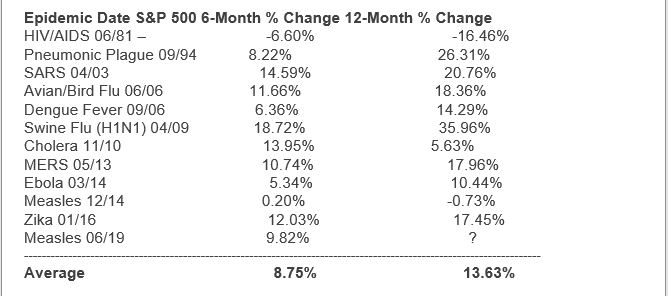
 Some asked me about the reference in my last email regarding the ‘number of epidemics over the last 40 years’, – they appear below.  My point simply is, we’ve seen tragic illness affect many over the centuries, not just in our times. Yet the financial markets have recovered, often in as little as six to 12 months and if it took longer, it was rare.

Not to make light of any illness, my picture appeared on the front page of the Herald News of Passaic, NJ in ‘55 wailing my eyes out having just received my Salk vaccine for polio. Remember, it crippled FDR, perhaps the greatest modern POTUS and killed many.


The best short-term advice I can offer is stop watching the news, especially financial news, take a short dose daily if you must just don’t leave it on all day! Practice social distancing and follow the rules to prevent the spread. Maintain PERSPECTIVE and things will get better- just look at history.

“To buy when others are despondently selling and to sell when others are greedily buying requires the greatest fortitude and pays the greatest reward.”-Sir John Templeton

Going back to 1930, if an investor missed the S&P 500’s 10 best days in each decade, total returns would be just 91%, significantly below the 14,962% returns for investors who held steady through the downturns. – CNBC, March 7, 2020


If you are concerned with the current crisis or have questions,
PLEASE call or email me and I will reply expeditiously.
MY JOB IS TO BE HERE WHEN THINGS ARE BAD!


Categories : Blog, Financial Services, Investments

How Consumers Spend Their Money

Posted by Frank McKinley on
 January 28, 2020

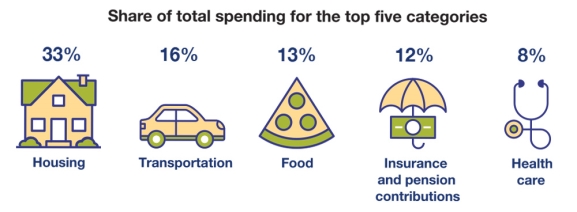
Each year, the Bureau of Labor Statistics reports on consumer spending patterns. According to the 2019 report, consumers spent an average of $61,224 in 2018.*

top 5 consumer spending categories

Is your Financial Plan Up-to-Date with your current situation?
Contact Frank if you would you like help with financial planning and understanding the somewhat confusing terms of the industry?

*Average annual expenditures per consumer unit. Consumer units include families, single persons living alone or sharing a household with others but who are financially independent, and two or more persons living together who share major expenses.

U.S. Bureau of Labor Statistics, Consumer Expenditures 2018, released September 2019
Prepared by Broadridge Investor Communication Solutions, Inc. Copyright 2020.
Categories : Blog, Financial Services

Could you survive a no-spend month?

Posted by Frank McKinley on
 January 21, 2020

Would you take on a 30-day challenge to spend money only on necessities such as rent, utilities, and groceries? During a no-spend month, many common activities — including dining out, buying movie or concert tickets, and shopping for clothes — are avoided at all costs.

The idea behind a 30-day challenge is that the time period is just long enough to help change bad habits without seeming intolerable. If frugality isn’t normally your forte, closely scrutinizing your spending could reap hundreds of dollars in savings. More important, it could help identify ways you might be wasting money on a regular basis.

Start by setting a positive goal for the money. Will you use the extra savings to pay down credit card debt or build up your emergency fund?

Here are some other ways to prepare for a successful challenge.

Time it right. Periods that include major holidays, planned vacations from work, and family birthdays are probably not the best for taking on this type of household experiment. On the other hand, it could be ideal to begin the new year with a “fiscal fast.”

Establish rules. Take your fixed expenses (i.e., rent/mortgage, utilities, phone bill, insurance payments) into account when planning your no-spend month. Evaluate your typical monthly discretionary spending to figure out where you can reduce or eliminate your spending for the month.

Plan to break patterns. Fill up your freezer and pantry with groceries and collect ideas for easy homemade meals. Steer clear of your personal spending triggers, which could mean staying off the Internet or waiting until later to meet up with friends who are big spenders.

Seek out free and fun entertainment. You don’t have to stay home for an entire month. Spend the day visiting a public park or beach, or look for free concerts, outdoor movies, art festivals, workshops, and other special events hosted by community groups.

Stay focused. When you get tempted to spend, remember your goal for the money you’ve saved. Keep a record of your progress to have a tangible reminder that your efforts will pay off.

Is your Financial Plan Up-to-Date with your current situation?
Contact Frank if you would you like help with financial planning and understanding the somewhat confusing terms of the industry?

Prepared by Broadridge Investor Communication Solutions, Inc. Copyright 2020.


Categories : Blog, Financial Services

Key Retirement and Tax Numbers for 2020

Posted by Frank McKinley on
 January 14, 2020

Every year, the Internal Revenue Service announces cost-of-living adjustments that affect contribution limits for retirement plans and various tax deduction, exclusion, exemption, and threshold amounts. Here are a few of the key adjustments for 2020.

Employer retirement plans

  • Employees who participate in 401(k), 403(b), and most 457 plans can defer up to $19,500 in compensation in 2020 (up from $19,000 in 2019); employees age 50 and older can defer up to an additional $6,500 in 2020 (up from $6,000 in 2019).
  • Employees participating in a SIMPLE retirement plan can defer up to $13,500 in 2020 (up from $13,000 in 2019), and employees age 50 and older can defer up to an additional $3,000 in 2020 (the same as in 2019).

IRAs

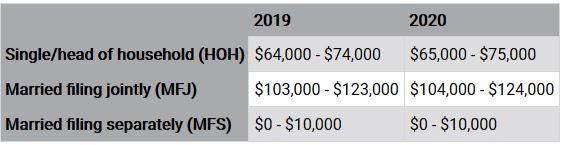
The combined annual limit on contributions to traditional and Roth IRAs is $6,000 in 2020 (the same as in 2019), with individuals age 50 and older able to contribute an additional $1,000. For individuals who are covered by a workplace retirement plan, the deduction for contributions to a traditional IRA phases out for the following modified adjusted gross income (MAGI) ranges:

Modified Adjusted Income Ranges

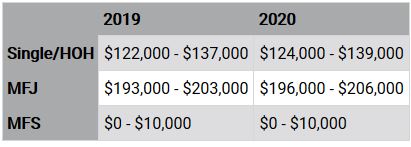
Note: The 2020 phaseout range is $196,000 – $206,000 (up from $193,000 – $203,000 in 2019) when the individual making the IRA contribution is not covered by a workplace retirement plan but is filing jointly with a spouse who is covered.

The modified adjusted gross income phaseout ranges for individuals to make contributions to a Roth IRA are:

Modified IRA Levels

Contact Frank if you would you like to schedule a no-obligation review of your retirement plan or financial plan and your tax plan for 2020.

Estate and gift tax

  • The annual gift tax exclusion for 2020 is $15,000, the same as in 2019.
  • The gift and estate tax basic exclusion amount for 2020 is $11,580,000, up from $11,400,000 in 2019.

Kiddie tax

Under the kiddie tax rules, unearned income above $2,200 in 2020 (the same as in 2019) is taxed using the trust and estate income tax brackets. The kiddie tax rules apply to: (1) those under age 18, (2) those age 18 whose earned income doesn’t exceed one-half of their support, and (3) those ages 19 to 23 who are full-time students and whose earned income doesn’t exceed one-half of their support.

Standard deduction
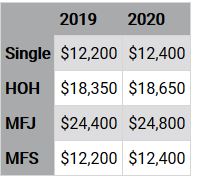
Standard Deduction Table

The additional standard deduction amount for the blind or aged (age 65 or older) in 2020 is $1,650 (the same as in 2019) for single/HOH or $1,300 (the same as in 2019) for all other filing statuses. Special rules apply if you can be claimed as a dependent by another taxpayer.

Alternative minimum tax (AMT)

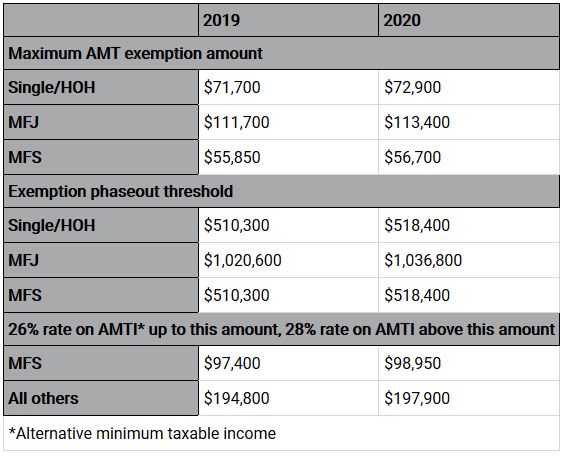
Alternative Minimum Tax Table

Prepared by Broadridge Investor Communication Solutions, Inc. Copyright 2020.


Categories : Blog, Financial Services, Tax
← Previous Page
Next Page →

Recent Newsletters & Blogs

  • And you think you have it bad…
  • Winter, BRRR…
  • U.S. Elections Spark Global Financial Uncertainty
  • THE ELECTION IS HEATING UP!
  • 3 Mistakes Investors Make During Election Years

Archives


Categories

  • 529 Savings Plans
  • Blog
  • Bonds
  • College Savings
  • Contributions
  • Credit Card Debt
  • estate planning
  • financial planning
  • Financial Services
  • Insurance
  • Investing
  • Investments
  • IRA
  • Life Insurance
  • Long-term Care
  • Medicaid
  • Medicare
  • Newsletters
  • Paycheck Protection Program
  • rebate payments
  • Retirement
  • ROTH
  • Savings
  • Savings Goals
  • Security
  • Social Security
  • socially responsible investing
  • Stocks
  • Tax
  • The CARES Act
  • the SECURE ACT
  • unemployment benefits
  • Wills
Frankly Financial | Copyright © 2014. All Rights Reserved.
Site Designed by TriDelta Design Group