

Learn about Socially Responsible Investing
Contact Frankly Financial for Retirement and Insurance Planning Assistance


It isn't how much you make
. . .It's how much you keep!

  • Home
  • About
  • Financial Planning
    • Overcoming Retirement Challenges
    • IRA Roll-Over Benefits
    • Saving for College Takes Careful Planning
  • Insurance
    • Guaranteed Investment Stream
    • Long-Term Health Care Insurance
  • Contact Frank

Archive for Financial Services – Page 15

Bear Markets Happen

Posted by Frank McKinley on
 April 15, 2020
At least annually, you should review your portfolio’s performance, comparing it to relevant benchmarks and determining whether you are making progress toward accomplishing your financial goals. Consider these steps in the process:
  • Measure the performance of each investment in your portfolio. Many investments and investment managers will provide you with periodic performance information.
When reviewing this information, keep in mind the following points:
  • Often, an investment’s return is reported on a time-weighted basis, which does not consider when you invested.
  • Information that reports your portfolio’s return is generally expressed on a dollar-weighted basis, which measures the investment return based on when cash inflows and out-flows occurred. While this is a more relevant measure when evaluating your portfolio, time-weighted returns can make it easier to compare the returns of different investments.
  • Investments often report cumu-lative annualized returns over a period of time, representing the aver-age annual performance over that

Continued on page 2

Frankly Speaking

Bear Markets HAPPEN!

The Black Death killed 20 million Europeans in the 14th century. Venice, a major trade port, grew nervous. If a ship was suspected of harboring the plague, it had to wait 40 days before any passengers or goods could come ashore. Venice built a quarantine center on an island off its coast, where sailors from plague-infested ships were sent either to get better or, more likely, to die. This 40-day waiting period became known as quarantinario, from the Italian word for 40. – –  NPR January 26, 2020

“The shortest period of time known to mankind is the time between when it is too soon to buy stocks and when it is too late.” – Mark Zinder

“Never let a good crisis go to waste.” – Winston Churchill

You may notice slight differences in this edition of Financial Success from my old newsletter. The latter was relatively generic while the former includes financial planning topics, from establishing goals and following economic trends to retirement, estate and tax planning, insurance and investments. A longer ‘sidebar’ will appear in the hard copy version and as an introduction to the HTML version. If you would like to see specific topics addressed, please let me know.

By now the Covid-19 or Wuhan virus has become as much a part of daily life as was the 10+ year stock market bull run in January. Did we really think it would last forever; that trees grew to the sky or that we had become so brilliant as to be impervious to the inevitability of periodic setbacks? Question is — did you re-balance your portfolio, shift some high performers to more conservative, fixed income-oriented positions or ‘guaranteed lifetime income accounts’*? Or has this ‘Black Swan’ event caught you entirely by surprise?

You may think there is no ‘getting back’ what you feel are losses, but if you haven’t sold or cashed out for CDs (Certificates of Depreciation), which offer less than the current rate of inflation.

PLEASE call or email me for a FREE no-cost, no-obligation consultation to see what we can do to improve your situation and create a brighter financial future for you and your family.

Click here to read the full article

*Based on the claims paying ability of the issuing company

Copyright © 2020. Some articles in this newsletter were prepared by Integrated Concepts, a separate, nonaffiliated business entity. This newsletter intends to offer factual and up-to-date information on the subjects discussed but should not be regarded as a complete analysis of these subjects. Professional advisers should be consulted before implementing any options presented. No party assumes liability for any loss or damage resulting from errors or omissions or reliance on or use of this material.

Categories : Blog, Financial Services

Some Short-Term Advice

Posted by Frank McKinley on
 April 15, 2020

First, let me thank all medical professionals, EMTs, Police, Fire, Safety and Essential Service workers for their efforts to help the public.

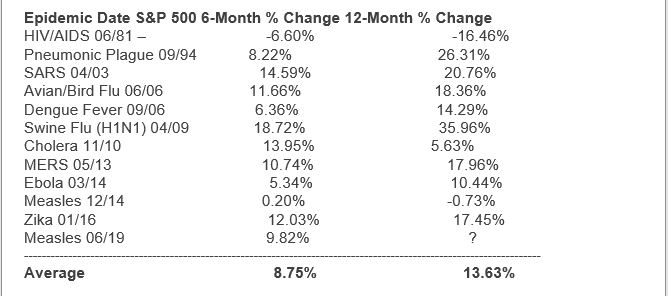
 Some asked me about the reference in my last email regarding the ‘number of epidemics over the last 40 years’, – they appear below.  My point simply is, we’ve seen tragic illness affect many over the centuries, not just in our times. Yet the financial markets have recovered, often in as little as six to 12 months and if it took longer, it was rare.

Not to make light of any illness, my picture appeared on the front page of the Herald News of Passaic, NJ in ‘55 wailing my eyes out having just received my Salk vaccine for polio. Remember, it crippled FDR, perhaps the greatest modern POTUS and killed many.


The best short-term advice I can offer is stop watching the news, especially financial news, take a short dose daily if you must just don’t leave it on all day! Practice social distancing and follow the rules to prevent the spread. Maintain PERSPECTIVE and things will get better- just look at history.

“To buy when others are despondently selling and to sell when others are greedily buying requires the greatest fortitude and pays the greatest reward.”-Sir John Templeton

Going back to 1930, if an investor missed the S&P 500’s 10 best days in each decade, total returns would be just 91%, significantly below the 14,962% returns for investors who held steady through the downturns. – CNBC, March 7, 2020


If you are concerned with the current crisis or have questions,
PLEASE call or email me and I will reply expeditiously.
MY JOB IS TO BE HERE WHEN THINGS ARE BAD!


Categories : Blog, Financial Services, Investments

Is It Time to Review Your IRA Estate Planning Strategies?

Posted by Frank McKinley on
 March 19, 2020

The Setting Every Community Up for Retirement Enhancement (SECURE) Act, which was passed in December 2019 as part of a larger federal spending package, included a provision that warrants special attention from those who own high-value IRAs. Specifically, the “stretch” IRA provision — which permitted non-spouse beneficiaries who inherited IRAs to spread distributions over their lifetimes — has been substantially restricted. IRA owners may want to revisit their estate planning strategies to help prevent their heirs from getting hit with higher-than-expected tax bills.

The old “stretch” rules

Under the old rules, a nonspouse beneficiary who inherited IRA assets was required to begin minimum distributions within a certain time frame. Annual distributions could be calculated based on the beneficiary’s life expectancy. This ability to spread out taxable distributions over a lifetime helped minimize the annual tax burden on the beneficiary. In the past, individuals could use this stretch IRA strategy to allow large IRAs to continue benefiting from potential tax-deferred growth for possibly decades.

Example: Consider the hypothetical case of Margaret, a single, 52-year-old banking executive who inherited a million-dollar IRA from her 85-year-old father. Margaret had to begin taking required minimum distributions (RMDs) from her father’s IRA by December 31 of the year following her father’s death. She was able to base the annual distribution amount on her life expectancy of 32.3 years. Since she didn’t really need the money, she took only the minimum amount required each year, allowing the account to continue growing. Upon Margaret’s death at age 70, the remaining assets passed to her 40-year-old son, who then continued taking distributions over the remaining 13.3 years of Margaret’s life expectancy. The account was able to continue growing for many years.

The new rules

As of January 2020, the rules for inherited IRAs changed dramatically for most nonspouse beneficiaries.1 Now they generally are required to liquidate the account within 10 years of the account owner’s death. This shorter distribution period could result in unanticipated and potentially large tax bills for high-value inherited IRAs.

Example: Under the new rules, Margaret would have to empty the account, in whatever amounts she chooses, within 10 years. Since she stands to earn her highest-ever salaries during that time frame, the distributions could push her into the highest tax bracket at both the federal and state levels. Because the account funds would be depleted after 10 years, they would not eventually pass to her son, and her tax obligations in the decade leading up to her retirement would be much higher than she anticipated.

Notable exceptions

The new rule specifically affects most nonspouse designated beneficiaries who are more than 10 years younger than the original account owner. However, key exceptions apply to those who are known as “eligible designated beneficiaries” — a spouse or minor child of the account owner; those who are not more than 10 years younger than the account owner (such as a close-in-age sibling or other relative); and disabled and chronically ill individuals, as defined by the IRS. The 10-year distribution rule will also apply once a child beneficiary reaches the age of majority and when a successor beneficiary inherits account funds from an initial eligible designated beneficiary.

A word about trusts

In the past, individuals with high-value IRAs have often used what’s known as conduit — or “pass-through” — trusts to manage the distribution of inherited IRA assets. The trusts helped protect the assets from creditors and helped ensure that beneficiaries didn’t spend down their inheritances too quickly. However, conduit trusts are now subject to the same 10-year liquidation requirements, so the new rules may render null and void some of the original reasons the trusts were established.

What can IRA account owners do?

IRA account owners should review their beneficiary designations with their financial or tax professional and consider how the new rules may affect inheritances and taxes. Any strategies that include trusts as beneficiaries should be considered especially carefully. Other strategies account owners may want to consider include converting traditional IRAs to Roths; bringing life insurance, charitable remainder trusts, or accumulation trusts into the mix; and planning for qualified charitable distributions.

1For account owners who died prior to December 31, 2019, the old rules apply to the initial beneficiary only (i.e., successor beneficiaries will be subject to the 10-year rule).

If you have questions or would like more information
please contact Frank


Representatives are registered through, and securities are sold through Nationwide Planning Associates, Inc., Member FINRA/SIPC, located at 115 West Century Road, Suite 360, Paramus, NJ 07652. Investment advisory services are offered through NPA Asset Management, LLC. Insurance sold through licensed NPA Insurance Agency, Inc. agents. Nationwide Planning Associates, Inc. and Frankly Financial are non-affiliated entities.
This communication is strictly intended for individuals residing in the state(s) of CO, CT, FL, NJ, NY, NC, OH, PA and RI. No offers may be made or accepted from any resident outside the specific states referenced.
Prepared by Broadridge Advisor Solutions Copyright 2020.


Categories : Financial Services, Investments, IRA, Retirement
Tags : IRA, ROTH, Trusts

Due Date Approaches for 2019 Federal Income Tax Returns

Posted by Frank McKinley on
 March 12, 2020

Tax Filing Time!Tax filing season is here again. If you haven’t done so already, you’ll want to start pulling things together — that includes getting your hands on a copy of your 2018 tax return and gathering W-2s, 1099s, and deduction records. You’ll need these records whether you’re preparing your own return or paying someone else to prepare your tax return for you.

Don’t procrastinate

The filing deadline for individuals is generally Wednesday, April 15, 2020.

Filing for an extension

If you don’t think you’re going to be able to file your federal income tax return by the due date, you can file for and obtain an extension using IRS Form 4868, Application for Automatic Extension of Time to File U.S. Individual Income Tax Return. Filing this extension gives you an additional six months (to October 15, 2020) to file your federal income tax return. You can also file for an extension electronically — instructions on how to do so can be found in the Form 4868 instructions.

Filing for an automatic extension does not provide any additional time to pay your tax. When you file for an extension, you have to estimate the amount of tax you will owe and pay this amount by the April filing due date. If you don’t pay the amount you’ve estimated, you may owe interest and penalties. In fact, if the IRS believes that your estimate was not reasonable, it may void your extension.

Note: Special rules apply if you’re living outside the country or serving in the military and on duty outside the United States. In these circumstances, you are generally allowed an automatic two-month extension (to June 15, 2020) without filing Form 4868, though interest will be owed on any taxes due that are paid after the April filing due date. If you served in a combat zone or qualified hazardous duty area, you may be eligible for a longer extension of time to file.

What if you owe?

One of the biggest mistakes you can make is not filing your return because you owe money. If your return shows a balance due, file and pay the amount due in full by the due date if possible. If there’s no way that you can pay what you owe, file the return and pay as much as you can afford. You’ll owe interest and possibly penalties on the unpaid tax, but you’ll limit the penalties assessed by filing your return on time, and you may be able to work with the IRS to pay the remaining balance (options can include paying the unpaid balance in installments).

Expecting a refund?

The IRS is stepping up efforts to combat identity theft and tax refund fraud. New, more aggressive filters that are intended to curtail fraudulent refunds may inadvertently delay some legitimate refund requests. In fact, the IRS is now required to hold refunds on all tax returns claiming the earned income tax credit or the additional child tax credit until at least February 15.

Most filers, though, can expect a refund check to be issued within 21 days of the IRS receiving a tax return.

If you have questions or would like more information
please contact Frank


Representatives are registered through, and securities are sold through Nationwide Planning Associates, Inc., Member FINRA/SIPC, located at 115 West Century Road, Suite 360, Paramus, NJ 07652. Investment advisory services are offered through NPA Asset Management, LLC. Insurance sold through licensed NPA Insurance Agency, Inc. agents. Nationwide Planning Associates, Inc. and Frankly Financial are non-affiliated entities.

This communication is strictly intended for individuals residing in the state(s) of CO, CT, FL, NJ, NY, NC, OH, PA and RI. No offers may be made or accepted from any resident outside the specific states referenced.

Prepared by Broadridge Advisor Solutions Copyright 2020.

Categories : Financial Services, Tax

World Epidemics and Global Stock Market Performance

Posted by Frank McKinley on
 March 4, 2020

Keep things in PERSPECTIVE!

Though the current news about Coronavirus is far from good, we’ve seen this movie before, and recovered from it EVERY TIME!  Remember, there have been 13 “world epidemics” since the mid-80’s and within six months the market had recovered from nearly all averaging a gain of 8.5%.

World epidemics and global stock market performanceIf you have any concerns about current market volatility,
PLEASE CONTACT ME!


Categories : Financial Services, Investments

The SECURE Act Offers New Opportunities for Individuals and Businesses

Posted by Frank McKinley on
 February 27, 2020

The SECURE Act (Setting Every Community Up for Retirement Enhancement Act) is major legislation that was passed by Congress as part of a larger spending bill and signed into law by the president in December. Here are a few provisions that may affect you. Unless otherwise noted, the new rules apply to tax or plan years starting January 1, 2020.

If you’re still saving for retirement

To address increasing life expectancies, the new law repeals the prohibition on contributions to a traditional IRA by someone who has reached age 70½. Starting with 2020 contributions, the age limit has been removed, but individuals must still have earned income.
If you’re not ready to take required minimum distributions

Individuals can now wait until age 72 to take required minimum distributions (RMDs) from traditional, SEP, and SIMPLE IRAs and retirement plans instead of taking them at age 70½. (Technically, RMDs must start by April 1 of the year following the year an individual reaches age 72 or, for certain employer retirement plans, the year an individual retires, if later).
If you’re adding a child to your family

Workers can now take penalty-free early withdrawals of up to $5,000 from their qualified retirement plans and IRAs to pay for expenses related to the birth or adoption of a child. (Regular income taxes still apply.)
If you’re paying education expenses

Individuals with 529 college savings plans may now be able to use account funds to help pay off qualified student loans (a $10,000 lifetime limit applies per beneficiary or sibling). Account funds may also be used for qualified higher-education expenses for registered apprenticeship programs. Distributions made after December 31, 2018, may qualify.*

If you’re working part-time

Part-time workers who log at least 500 hours in three consecutive years must be allowed to participate in a company’s elective deferral retirement plan. The previous requirement was 1,000 hours and one year of service. The new rule applies to plan years beginning on or after January 1, 2021.

If you’re an employer offering a retirement plan

Employers that offer plans with an automatic enrollment feature may automatically increase employee contributions until they reach 15% of pay (the previous cap was 10% of pay). Employees will have the opportunity to opt out of the increase.

Small employers may also benefit from new tax credit incentives. The tax credit that small businesses may take for starting a new retirement plan has increased. Employers may now take a credit equal to the greater of (1) $500 or (2) the lesser of (a) $250 times the number of non-highly compensated eligible employees or (b) $5,000. The previous maximum credit amount allowed was 50% of startup costs up to a maximum of $1,000 (i.e., a $500 maximum credit).

In addition, a new tax credit of up to $500 is available to employers that launch a new SIMPLE IRA or 401(k) plan with automatic enrollment.

These credits are available for three years, and employers that qualify may claim both credits.

*There are generally fees and expenses associated with 529 savings plan participation. Investments may lose money or not perform well enough to cover college costs as anticipated. Investment earnings accumulate on a tax-deferred basis, and withdrawals are tax-free if used for qualified higher-education expenses. For withdrawals not used for qualified higher-education expenses, earnings may be subject to taxation as ordinary income and possibly a 10% federal income tax penalty. Discuss the tax implications of a 529 savings plan with your legal and/or tax advisors; these can vary significantly from state to state. Most states offer their own 529 plans, which may provide advantages and benefits exclusively for residents and taxpayers, including financial aid, scholarship funds, and protection from creditors.

Before investing in a 529 savings plan, consider the investment objectives, risks, charges, and expenses carefully. Obtain the official disclosure statements and applicable prospectuses — which contain this and other information about the investment options, underlying investments, and investment company — from your financial professional. Read these materials carefully before investing.

If you have questions or would like more information
please contact Frank


Representatives are registered through, and securities are sold through Nationwide Planning Associates, Inc., Member FINRA/SIPC, located at 115 West Century Road, Suite 360, Paramus, NJ 07652. Investment advisory services are offered through NPA Asset Management, LLC. Insurance sold through licensed NPA Insurance Agency, Inc. agents. Nationwide Planning Associates, Inc. and Frankly Financial are non-affiliated entities.

This communication is strictly intended for individuals residing in the state(s) of CO, CT, FL, NJ, NY, NC, OH, PA and RI. No offers may be made or accepted from any resident outside the specific states referenced.

Prepared by Broadridge Advisor Solutions Copyright 2020.


Categories : Financial Services, IRA, Retirement
← Previous Page
Next Page →

Recent Newsletters & Blogs

  • And you think you have it bad…
  • Winter, BRRR…
  • U.S. Elections Spark Global Financial Uncertainty
  • THE ELECTION IS HEATING UP!
  • 3 Mistakes Investors Make During Election Years

Archives


Categories

  • 529 Savings Plans
  • Blog
  • Bonds
  • College Savings
  • Contributions
  • Credit Card Debt
  • estate planning
  • financial planning
  • Financial Services
  • Insurance
  • Investing
  • Investments
  • IRA
  • Life Insurance
  • Long-term Care
  • Medicaid
  • Medicare
  • Newsletters
  • Paycheck Protection Program
  • rebate payments
  • Retirement
  • ROTH
  • Savings
  • Savings Goals
  • Security
  • Social Security
  • socially responsible investing
  • Stocks
  • Tax
  • The CARES Act
  • the SECURE ACT
  • unemployment benefits
  • Wills
Frankly Financial | Copyright © 2014. All Rights Reserved.
Site Designed by TriDelta Design Group