
Learn about Socially Responsible Investing
Contact Frankly Financial for Retirement and Insurance Planning Assistance


It isn't how much you make
. . .It's how much you keep!

  • Home
  • About
  • Financial Planning
    • Overcoming Retirement Challenges
    • IRA Roll-Over Benefits
    • Saving for College Takes Careful Planning
  • Insurance
    • Guaranteed Investment Stream
    • Long-Term Health Care Insurance
  • Contact Frank

Archive for Financial Services – Page 12

2020 Year-end Financial Ideas

Posted by Frank McKinley on
 November 15, 2020

Convert Traditional to ROTH IRA money for TAX-FREE distribution in retirement AND to avoid RMDs – must be done by Dec. 31, NOT April 15 of next year. (May be subject to Federal, State and/or Local income tax.)

Fully fund ALL retirement accounts: 401Ks, 403bs, 457 plans, IRAs, SEPs and SIMPLES – Do you know the limits? If not PLEASE call me!

Are all your beneficiary designations in order? AND

Are all your Estate Plan documents in order? Call me for FREE templates.

Did you turn any of these ages in 2020?

AGEEligiblity
50You may be eligible to make ‘catch-up’ contributions to an IRA or employer plan.
55You may be eligible to take a distribution from your 401K without being subject to the 10% early distribution penalty.
59 1/2You may be eligible to take a penalty-free distribution from your IRA and company plan.
59 1/2And you may be able to take tax-free distributions from your ROTH assuming it has been open at least 5 years.
62You may apply for Social Security.
65You may apply for Medicare.
72Must begin taking RMDs from IRAs and company plans but not ROTHs

If you would like more information or to discuss your financial concerns

Click Here
Categories : financial planning, Financial Services
Tags : year-end planning

Insurance and Financial Planning – Where Do I Start?

Posted by Frank McKinley on
 November 10, 2020

Insurance plays a vital role in your financial plan.  A comprehensive insurance plan, which can include everything from auto insurance to disability insurance, helps protect you, your family, and your wealth.

Without insurance, most people would have difficultly coping with major and unexpected financial setbacks. Insurance is a reasonable way to plan for worst-case scenarios. In many ways, it’s the bedrock that supports your overall financial security. Some might even argue that if you have to prioritize, it’s more important to focus on developing a solid insurance plan before you worry about issues like investing.

Where Do I Start?

Most people already have some insurance. A typical adult with a family and a job might carry auto, life, and homeowners insurance (not to mention health insurance, which is another essential coverage). But most people purchase their insurance piecemeal, picking up a policy here and there when they need it. Rarely do people have a coordinated insurance plan that aligns with their overall financial plan.

Thus, your first step in developing an insurance plan should be sitting down and taking an objective look at your total financial situation, perhaps with the help of a financial advisor. Consider your age, family situation, the risks you face, and current assets and liabilities. This will help you identify areas where
you might need the peace of mind that quality insurance provides.

For example, parents with young children will almost certainly want life insurance, while people who suspect there’s a good chance they’ll end up in a nursing home may want long-term-care insurance. Sound complicated? It can be. Unfortunately, there is no one-size-fits-all approach to buying  insurance.

develop and insurance plan

Evaluating Your Risk and Determining Your Needs

Determining what kind of insurance you need to protect yourself and your family begins with an honest evaluation of the risks you face.  But that’s just the beginning. For example, if you have young children, you probably know you need life insurance. But how much is enough and what variety (whole or term) is best? And what about other types of coverage? Should you buy umbrella insurance or disability insurance?

Life insurance tends to be the area where people have the most questions about whether their coverage is adequate. To do this, you need to imagine the unthinkable: How would your family survive if you were no longer there to support them? Don’t just pick a big number and assume it will be enough.

Consider this: You have a life insurance policy with a $1 million death benefit that you think will be more than enough to provide for your family if you pass away unexpectedly. Tragically, you die, and your surviving spouse uses $400,000 of the benefit to pay off your mortgage and some other debts, pay for your funeral, and cover other miscellaneous expenses. That leaves just $600,000 for your family.  If your survivors invest that sum in a fund that earns an average 5%, that translates to a monthly income of $2,500. That amount may not be enough to meet all your survivors’ financial needs. And that assumes your financial situation is relatively uncomplicated. If you
have children with special needs or who will be attending college soon, you may need even more insurance.

When it comes to disability insurance, you may be tempted to rely on your company’s policy, but that might be a mistake as well. The coverage may not be as extensive as you expect, with a limited benefit period or a narrow definition of disability (you may only get benefits if you aren’t able to work in any occupation, not just your current occupation). Robust disability  insurance coverage is essential if you do not have the resources to replace your current income should you become unable to work.

Long-term-care insurance is another essential component of many people’s financial plan. Given the high cost of nursing home care or a stay in an assisted-living facility, the need for these types of services in retirement would bankrupt many, even those with substantial retirement savings. If you suspect that you or your spouse might need such care, a long-term-care policy is one way to protect your assets and reduce the risk that you will run out of money paying for a nursing home stay.

Clearly, insurance and financial planning are intimately intertwined. It is difficult to separate one from the other. If you have questions about whether your current insurance coverage fits with your overall financial needs, please call to discuss this in more detail.

If you would like more information or to discuss your insurance or financial concerns

Click Here
Copyright © 2020. Some articles in this newsletter were prepared by Integrated Concepts, a separate, non-affiliated business entity. This newsletter intends to offer factual and up-to-date information on the subjects discussed but should not be regarded as a complete analysis of these subjects. Professional advisers should be consulted before implementing any options presented. No party assumes liability for any loss or damage resulting from errors or omissions or reliance on or use of this material.

Categories : Blog, Financial Services, Insurance, Life Insurance

Think Positive. . .

Posted by Frank McKinley on
 October 31, 2020
2020-11-20-newsletter


Categories : financial planning, Financial Services, Newsletters

Got Yield?

Posted by Frank McKinley on
 October 23, 2020

The last time the yield on the 10-year Treasury note was above 1% was on 3/19/20 or 7 months ago today. The 10-year note yield closed at 0.74% last Friday 10/16/20 (source: Treasury Department).

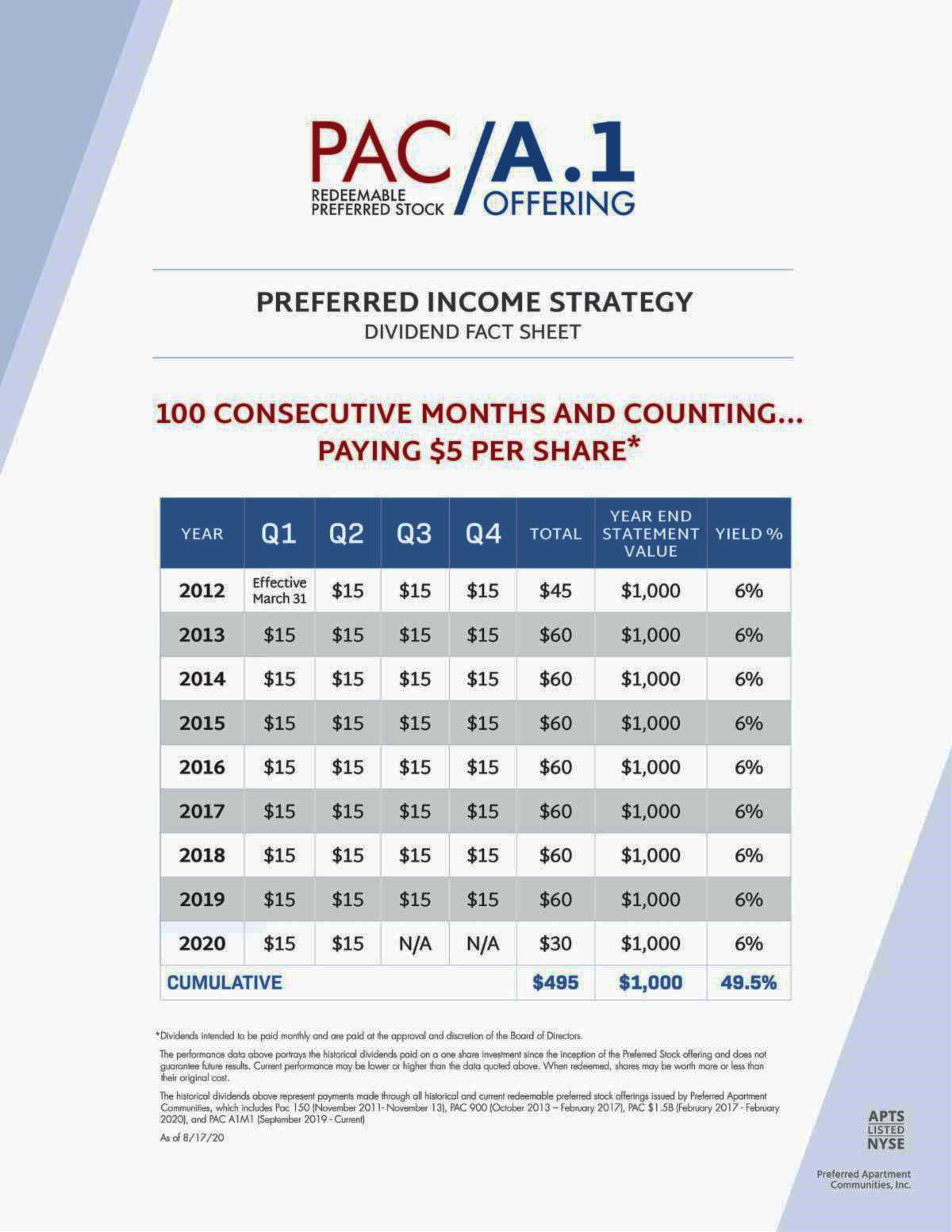
Preferred Apartment Communities has paid a consistent 6% dividend since inception, Q1, 2012. For more information on How To Invest, Please call Frank.

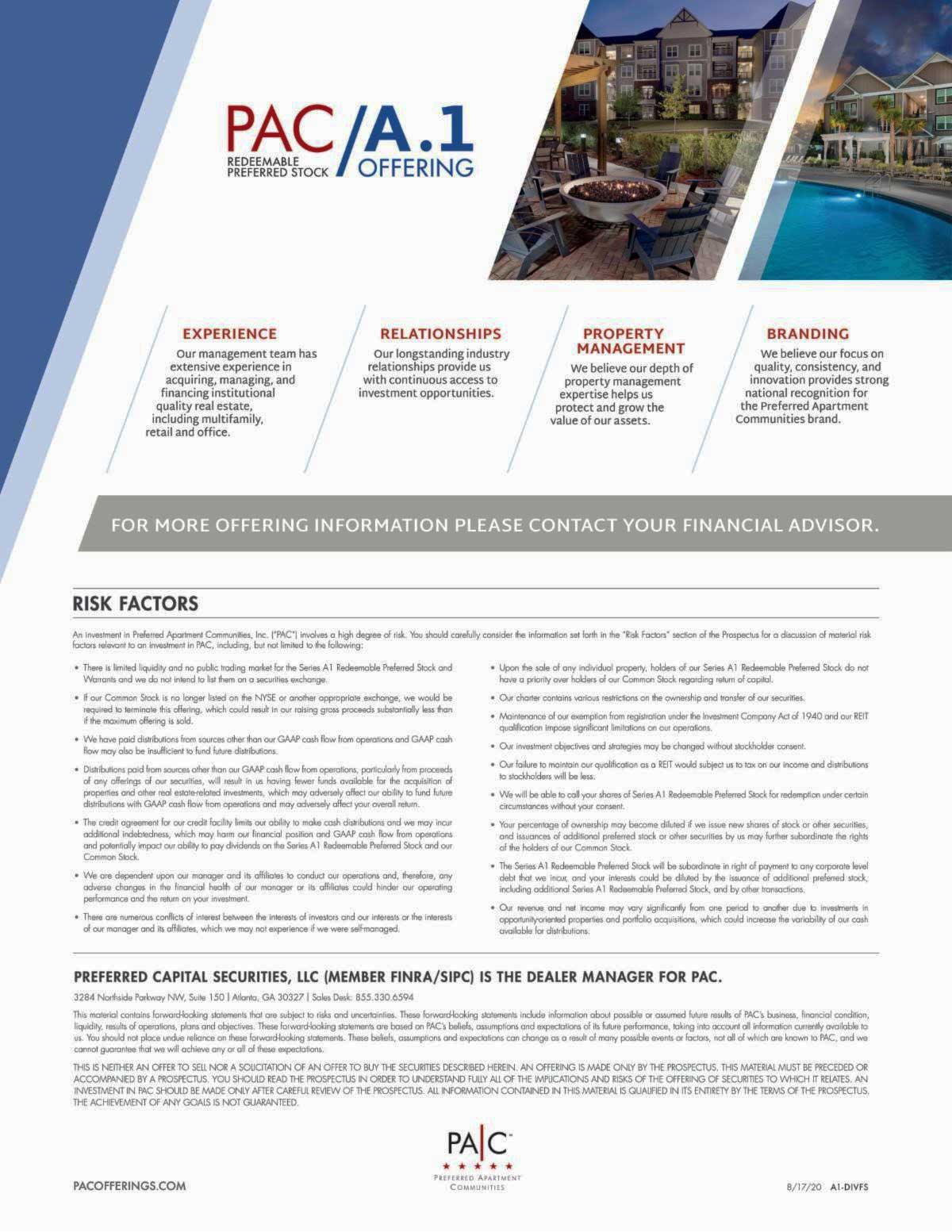
redeemable preferred stock risk factors
Download Here

If you would like more information or to discuss your financial concerns

Click Here
Categories : Blog, Financial Services, Investing, Investments, Stocks

Watching Your Stocks

Posted by Frank McKinley on
 October 20, 2020

No matter how often you prefer to monitor your stocks’ performance, there are certain items you should consider. Here are five things to review as you monitor your stocks’  performance:

Earnings — Pay attention to the company’s  quarterly and annual earnings statements, which include comparisons with the recent past and often reviews of what management expects for the next quarter and year. Review the stock’s earnings trend and how the company performs compared to analysts’ estimates. Watch out for earnings surprises, which can cause rapid price changes up or down, and may indicate the start of a new stock price trend.

Price and dividends — Follow
the stock’s price compared to its
52-week highs and lows. Examine its trailing total returns year to date and over the last one-, three-, five-, and 10-year periods. Look for changes in the absolute dollar amount of dividends and the current yield (the annual dividend divided by the current price).

P/E and PEG ratios — Price to earnings (P/E) and price/earnings growth (PEG) ratios are often better indicators than the stock price as to how relatively expensive or cheap a stock is.

The P/E ratio is useful for comparison to other stocks and the market, while the PEG ratio is a strong indicator of whether the stock is overpriced or underpriced compared to its projected earnings growth rate over the next five years.

Insider transactions and stock
buybacks
— A company buying
back its own stock or whose senior
executives and directors are accumulating more shares is a bullish sign.
On the other hand, when insiders are selling off major holdings of their own stock, it’s quite often an indication that the stock price has peaked.

Sudden and large price changes
on high volume
— When a stock
makes a sudden, high-volume move
— particularly when it opens much
higher or lower than the previous day’s high or low — it can be the start of a new, long-term trend.

For help monitoring your stocks’ performance, or if you need to make a change to your investment portfolio, please call.

Dividend Investing

Dividend investing creates both an income stream from dividends as well as portfolio growth from asset appreciation.

The first thing dividend investors look for is safety, which is measured by the dividend coverage ratio. Typically, dividend investors
don’t want to see companies pay out more than 60% of their profits as dividends to investors to ensure the company has the resources for operations. Dividend investors look for companies that have good cash flow and stable income, because they can get a higher payout ratio and don’t have to worry about the company’s ability to pay the dividend.

When an investor follows the high dividend yield strategy, he/she is investing in companies with yields at the top of the range that will provide a predictable income stream. Investors who focus on a high dividend growth strategy are investing in companies whose dividend payments are significantly lower than average, but the company is growing at a very fast rate.

After a period of time, these fast-growing
companies can increase dividends to an equal or much higher level than what would have
been collected using the high dividend yield approach.

Financial Thoughts

In a recent survey, 9% of non-retiree respondents said that they knew for certain what their Social Security benefits would be, 41% had a guess or estimate, and 49% had no idea how much their benefits would be (Source: AAII Journal, March 2020).

A recent study found that individuals with children have 10% less wealth by retirement age than individuals without children. However, individuals with children were

just as satisfied with retirement as those without children. One of the reasons for this
difference is that retirement saving goals differ in meaningful ways between the two groups.  (Source: American Enterprise
Institute, December 2019).

Consumers worldwide put an average value of $35,000 on digital assets stored on their mobile devices, which includes photos and videos (Source: Journal of Financial Planning, April 2020).

About 81% of U.S. adults age 72 and older have a healthcare power of attorney, while only 41% of millennials have one (Source:
AARP, 2020).

Approximately 20% of baby boomers who receive an inheritance of $100,000 or more spend the entire inheritance.  (Source:
Journal of Family and Economic Issues, 2020).

If you would like more information or to discuss your financial concerns

Click Here
Representatives are registered through, and securities are sold through Nationwide Planning Associates, Inc., Member FINRA/SIPC, located at 115 West Century Road, Suite 360, Paramus, NJ 07652. Investment advisory services are offered through NPA Asset Management, LLC. Insurance sold through licensed NPA Insurance Agency, Inc. agents. Frank is registered in NJ, NY, PA, FL, CT, CO, NC, OH and RI. He is also licensed for life and health insurance in NJ, NY, FL, OH and RI. The presence of this web site on the Internet shall in no direct or indirect way be construed or interpreted as a solicitation to sell advisory services to residents of any state other than those listed above and shall not be deemed to be a solicitation of advisory clients living in any state other than those listed above. Nationwide Planning Associates, Inc. and Frankly Financial are non-affiliated entities.
Copyright © 2020. Some articles in this newsletter were prepared by Integrated Concepts, a separate, non-affiliated business entity. This newsletter intends to offer factual and up-to-date information on the subjects discussed but should not be regarded as a complete analysis of these subjects. Professional advisers should be consulted before implementing any options presented. No party assumes liability for any loss or damage resulting from errors or omissions or reliance on or use of this material.

Categories : Financial Services, Investing, Investments, Stocks

New to Investing? Avoid These Mistales

Posted by Frank McKinley on
 October 13, 2020

I f you are new to investing, there is no doubt that you will make some mistakes; it just goes with the territory. However, you should familiarize yourself with these common mistakes and take steps to avoid them.

No Investment Plan — Many investors just get started in the stock market without giving any thought as to what they are trying to accomplish. It is important to have a plan that will keep you on track and help you ride out turbulent markets. Your plan should include:

Goals — Define what you are
trying to accomplish so you
can measure your portfolio’s performance in meeting your goals. You will want to be as specific as possible,
such as accumulating $1 million for retirement by age 60 or $100,000 for your child’s  education within 15 years.

Risk Tolerance — Define how much risk you are comfortable with so you can determine an appropriate allocation for your assets. Stocks are riskier than bonds and will fluctuate more than other asset classes, so you want to figure out how much risk you are willing to assume. The younger you are, the more risk you can typically assume,

Carefully determine your risk tolerance

since you have more time to overcome any declines in your investments.

Asset Allocation — You will want to determine how to allocate your assets across different investments, such as stocks, bonds, etc.

Diversification — Once you determine your asset allocation, you will want to diversify within each individual asset class. For example, when investing in stocks, you will want to spread your funds across large-, mid-, and smallcap stocks.

Time Horizon — Don’t wait too long to start investing because time is your friend. If you
are saving for retirement, plan on 30 years of investing to meet your goals. If you don’t allocate enough time to meet a specific goal, you will need to adjust your asset allocation
to help you meet the goal within a shorter timeframe. For example, if you start saving for a child’s college education when he/she is a
freshman in high school, your assets will most likely need to be allocated more heavily to stocks in an attempt to meet that timeframe.

Stop the Noise — Be careful
with how much time you spend and
the credence you lend to the financial
media. Media noise can be hard
to turn off, but remember the best
advice is to stick to your plan.

Not Rebalancing — You will want to review your portfolio regularly and rebalance if it strays from your target asset allocation. When
you allow your portfolio to drift based on market returns, some asset classes will be overweighted at market peaks and  underweighted at market lows, which may lead to poor performance. While it will sometimes feel counterintuitive to sell assets that are performing well for those that are not performing as well, your target asset allocation
will lead to a stronger performance in the long term.

chasing performance as the single factor for a stock purchaseChasing Performance — Many investors are always trying to find the next big investment. They will rely on recent strong performance
as the single factor in purchasing an investment. If a certain stock has been doing extremely well for a number of years, you should probably have invested in it years ago,
since it may be nearing the end of its high performing cycle.

When an investment is doing extremely well, many people will not sell and take the profit because they are afraid that it will continue
to increase in value. But there is also the risk that it will go down in value.

You should also consider identifying a target value at which you will sell your stocks. This will help take the emotion out of your sell
decisions.

Becoming Too Emotional — It’s hard not to get emotional when the market encounters a severe correction, but the investors who have
the ability to remain calm during these times more consistently outperform the market. If you start selling off investments at the worst
possible time, you may then be out of the market when it starts to rebound.

While it is easier said than done, you have to build a resistance to those things that create emotional triggers so you don’t make bad
decisions. Thoughtfully consider new information, don’t just follow the crowd, and make decisions when you are calm based on your long-term plan.

If you would like more information or to discuss this in more detail

Click Here
Representatives are registered through, and securities are sold through Nationwide Planning Associates, Inc., Member FINRA/SIPC, located at 115 West Century Road, Suite 360, Paramus, NJ 07652. Investment advisory services are offered through NPA Asset Management, LLC. Insurance sold through licensed NPA Insurance Agency, Inc. agents. Frank is registered in NJ, NY, PA, FL, CT, CO, NC, OH and RI. He is also licensed for life and health insurance in NJ, NY, FL, OH and RI. The presence of this web site on the Internet shall in no direct or indirect way be construed or interpreted as a solicitation to sell advisory services to residents of any state other than those listed above and shall not be deemed to be a solicitation of advisory clients living in any state other than those listed above. Nationwide Planning Associates, Inc. and Frankly Financial are non-affiliated entities.
Copyright © 2020. Some articles in this newsletter were prepared by Integrated Concepts, a separate, non-affiliated business entity. This newsletter intends to offer factual and up-to-date information on the subjects discussed but should not be regarded as a complete analysis of these subjects. Professional advisers should be consulted before implementing any options presented. No party assumes liability for any loss or damage resulting from errors or omissions or reliance on or use of this material.
Categories : Bonds, Financial Services, Investing, Investments, Stocks
← Previous Page
Next Page →

Recent Newsletters & Blogs

  • And you think you have it bad…
  • Winter, BRRR…
  • U.S. Elections Spark Global Financial Uncertainty
  • THE ELECTION IS HEATING UP!
  • 3 Mistakes Investors Make During Election Years

Archives


Categories

  • 529 Savings Plans
  • Blog
  • Bonds
  • College Savings
  • Contributions
  • Credit Card Debt
  • estate planning
  • financial planning
  • Financial Services
  • Insurance
  • Investing
  • Investments
  • IRA
  • Life Insurance
  • Long-term Care
  • Medicaid
  • Medicare
  • Newsletters
  • Paycheck Protection Program
  • rebate payments
  • Retirement
  • ROTH
  • Savings
  • Savings Goals
  • Security
  • Social Security
  • socially responsible investing
  • Stocks
  • Tax
  • The CARES Act
  • the SECURE ACT
  • unemployment benefits
  • Wills
Frankly Financial | Copyright © 2014. All Rights Reserved.
Site Designed by TriDelta Design Group