
Learn about Socially Responsible Investing
Contact Frankly Financial for Retirement and Insurance Planning Assistance


It isn't how much you make
. . .It's how much you keep!

  • Home
  • About
  • Financial Planning
    • Overcoming Retirement Challenges
    • IRA Roll-Over Benefits
    • Saving for College Takes Careful Planning
  • Insurance
    • Guaranteed Investment Stream
    • Long-Term Health Care Insurance
  • Contact Frank

Archive for Financial Services – Page 13

Estate Planning Considerations for Children

Posted by Frank McKinley on
 October 6, 2020

It takes special care to create an estate plan that efficiently distributes your assets and meets your goals for every person and cause important to you. But no part of the process means more to most people than that which involves their children. After all, for most of us, our children are our most important legacy, and how your estate documents treat them will have an impact long after you’re gone.

To help organize this process, it is useful to think of children in three categories: minors, young adults, and fully grown adults with spouses and children of their own.

Minor Children

Children from infancy through high school have a different set of needs than children of other ages. One is simply to be able to rely on an income for daily needs in case you’re no longer there for them.  Since the parents of young children usually don’t have large savings or net worth, the challenge is to provide an instant estate, for which life insurance is the best answer.

Family Estate Planning There are several rules of thumb for how much life insurance to buy — from four to 10 times your annual income. The right amount should be the result of a thorough needs analysis of your entire family, which can be accomplished by asking your spouse and yourself a series of probing questions, including:

How much do the two of you already have saved?

Will your spouse be able to work full- or part-time? If so, what will childcare cost?

Will your children go to public or private elementary and secondary schools?

How much will your children need in college funds by the time they’re ready to attend?

How much will your spousen eed for retirement, and how much of that will he/she be able to accumulate on his/her own?
After you determine how much life insurance to buy, you need to think about who will raise your children if you and your spouse both die before the children are adults. This calls for naming a guardian in both of your wills. If you don’t have a will, a state court will appoint a guardian for you, and it may not be someone you or your spouse would have wanted for this role. In addition, parents might also wish to designate a person to manage the children’s assets, known as a custodian or trustee. This can be the same person as the guardian, but designating an unrelated third party, like an attorney, banker, or trust company officer, who can be charged with thinking only of your children’s welfare,  appeals to some people.

Among the other major decisions you have to make is whether and how to split your assets among your surviving spouse and your children, and if you leave some assets directly to your children, how to determine the split among them.

Often, it can make sense to leave all or most of your assets to your spouse and to divide assets you bequeath to your children evenly. But this might overlook such considerations as children with special medical needs or special abilities.

Young Adults

Once children reach the age of majority — 18 in most states — a new set of considerations enters the picture. By this age, your children no longer  require a guardian and are legally capable of spending their money in any way they want — and therein lies a potential problem. What if you leave $250,000 for college, and instead, your children decide to waste the money and skip college?

One way to control how the inheritance is spent is to establish a trust with a  schedule for distributions. One option is to delay a full distribution until they reach a certain age, like 25 or 30. another choice is to give them a series of partial distributions over many years. Another increasingly popular strategy is the incentive trust. This vehicle makes payouts contingent on your child’s achievement of specific accomplishments — like maintaining a certain grade point average; graduating from college, graduate, or professional school; marrying; or buying a home.

Adult Children

Many of the same kinds of considerations that apply to minors and young adults can also influence your decisions regarding your adult
children. Do they, their spouses, or their children have special medical
needs? Have your adult children fallen on hard times or are they irresponsible with money? How many children do they have and how
much help will they need to finance their education?

Another consideration has as much to with your own objectives for minimizing estate taxes. If your estate is much larger than you and
your spouse’s combined estate tax exemptions (currently $11.58 million
for each spouse in 2020), you might want to shrink it with an aggressive campaign of gifts to your children and grandchildren. On the other hand, any funds you leave to your children might encumber them with estates equally as large as yours or larger, with the same tax challenges. In this case, you might want to transfer some of your assets to a generation-skipping trust, which bypasses your children and names your grandchildren as the beneficiaries.

Don’t go it alone when mulling over these decisions. Most importantly,
you need to reach a meeting of the minds with your spouse and even your children, especially if they are adults. One thing you don’t want to do is to create bad feelings after you’re gone, either toward you or among your survivors.

Frankly Speaking

“It is not the strongest species that survive, nor the most intelligent, but the most responsive to change.” – Charles Darwin

“Men, it has been well said, think in herds; it will be seen that they go mad in herds, while they only recover their senses slowly,
one by one.”
– Charles MacKay

“Nothing sedates rationality like large doses of effortless
money.”
– Warren Buffett

With markets bouncing around all-time highs recently, pending
elections and political unrest creating additional emotion and drama, one can only speculate where the indexes may be going. Yet when the market is high, so is risk. Will you accept more risk and ‘ride the tiger’, or consider a more rational approach toward fixed income or even guaranteed income accounts*?

*All guarantees and protections are subject to the claims-paying ability of the issuing company.

If you would like more information or to discuss your financial concerns

Click Here
Representatives are registered through, and securities are sold through Nationwide Planning Associates, Inc., Member FINRA/SIPC, located at 115 West Century Road, Suite 360, Paramus, NJ 07652. Investment advisory services are offered through NPA Asset Management, LLC. Insurance sold through licensed NPA Insurance Agency, Inc. agents. Frank is registered in NJ, NY, PA, FL, CT, CO, NC, OH and RI. He is also licensed for life and health insurance in NJ, NY, FL, OH and RI. The presence of this web site on the Internet shall in no direct or indirect way be construed or interpreted as a solicitation to sell advisory services to residents of any state other than those listed above and shall not be deemed to be a solicitation of advisory clients living in any state other than those listed above. Nationwide Planning Associates, Inc. and Frankly Financial are non-affiliated entities.
Copyright © 2020. Some articles in this newsletter were prepared by Integrated Concepts, a separate, non-affiliated business entity. This newsletter intends to offer factual and up-to-date information on the subjects discussed but should not be regarded as a complete analysis of these subjects. Professional advisers should be consulted before implementing any options presented. No party assumes liability for any loss or damage resulting from errors or omissions or reliance on or use of this material.

Categories : estate planning, financial planning, Financial Services

The Truth About Presidential Elections

Posted by Frank McKinley on
 September 16, 2020

Politics and investing have always been spoken about in the same breath. Commentators and candidates alike often frame the performance of the stock market as a sort of “barometer” of a president’s policies. But the data don’t support this link. Over the past 120 years, the long-term performance of the market has shown almost no correlation with government policies.

So what’s the real story when it comes to politics and investing?

Consider these historical truths:

1. Markets have performed well under both parties

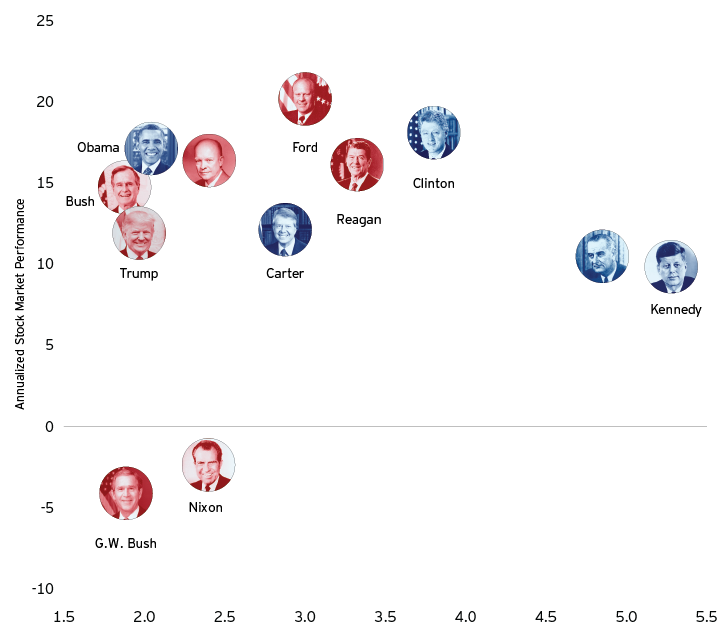
Neither party can lay claim to superior economic or financial market performance. The S&P 500 Index delivered an average annual return of approximately 11% over the past 75 years, through both Democratic and Republican administrations. The US economy also expanded around 3.0% during that period.1

Presidential term stock market return vs. economic growth (1957-present)

markets performed well under both parties

2. Markets don’t care if you don’t approve of the president

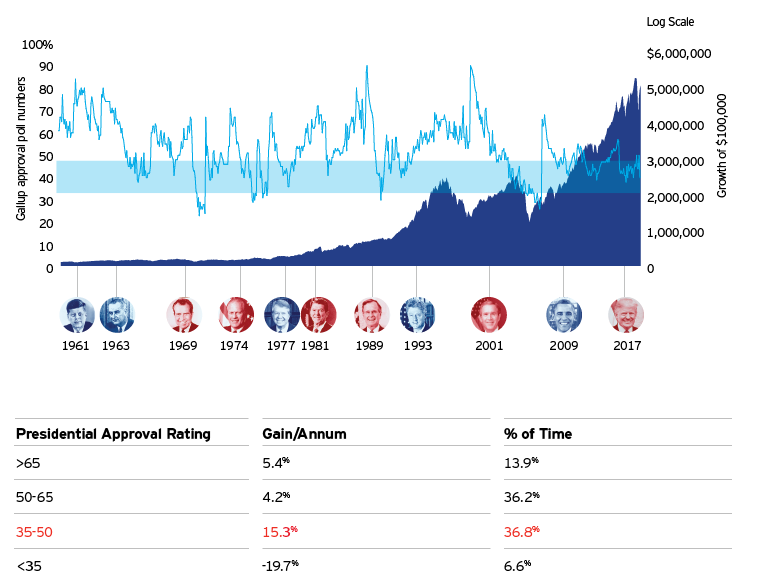
From the inauguration of President Kennedy through the current administration of President Trump, some of the best returns in the stock market have come when the president’s approval rating was between 36% and 50% — in other words, when at least half the country disapproved of the job performance of the sitting president.2

Gallup poll presidential approval ratings and the growth of $100,000

markets don't care if your don't approve of the president

3. Signature legislation often doesn’t impact the economy as expected

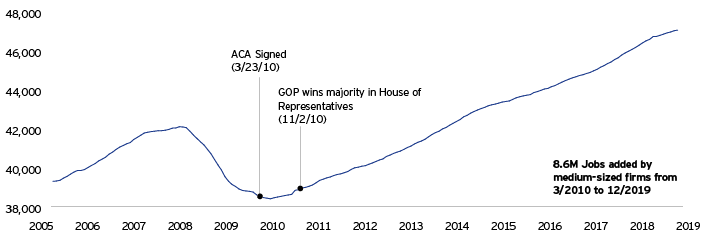
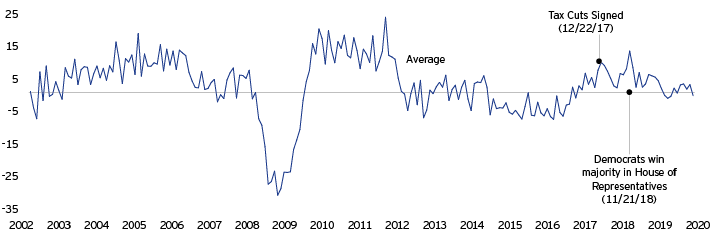
Predictions about the ultimate impact of legislation are often far removed from the actual results. For instance, it was predicted that President Obama’s Patient Protection and Affordable Care Act of 2010 would destroy small-business hiring. But since it was implemented, 8.6 million jobs have been added in this sector.3 Similarly, President Trump’s Tax Cut and Jobs Act of 2017 was intended to unlock capital expenditures, but it has thus far failed to bring an acceleration in business investment as issues such as trade uncertainty and, most recently, Coronavirus have impacted confidence.

Example 1: Patient Protection and Affordable Care Act

Employers with 50 or more full-time employees are considered “large business” and therefore required to offer employee health coverage or pay a penalty.

Non-farm private medium payroll employment (50-499)

Signature legislation often has no impact on the economy

Example 2: Tax Cuts and Jobs Act of 2017

Section 179 allows taxpayers to deduct the cost of certain property (such as machinery and equipment purchased for use in trade or business) as an expense when property is placed in service.

US capital goods new orders (nondefense ex-aircraft and parts)

tax cuts and job acts of 2017

Learn more about what really matters to markets

These are just some of the essential truths about elections and investing. Click here to see a brochure which clearly and simply illustrates these three, plus seven more:

  • Investors are better off staying fully invested.
  • We do not radically re-engineer the US economy.
  • The historical narrative is not as you remember it.
  • Predictions tend to be wrong.
  • Monetary policy matters more.
  • No, this is not the most vitriolic election.
  • Don’t confuse partisan politics with market analysis

1. Haver, Invesco, 6/30/20. Note: President Trump stock market performance data from 1/20/17-6/30/20., real GDP data from 12/31/2016 to 3/31/2020 as GDP is reported with a lag. Stock market performance is defined by the total return of the S&P 500 Index.
2. Bloomberg, L.P., 6/30/20. An investment cannot be made in an index.
3. Bloomberg, L.P., FRED, 3/31/20. Most recent data available.
See Index definitions on page 13 of the brochure.
Past performance does not guarantee future results

MY JOB IS TO BE HERE WHEN THINGS ARE BAD!

If you would like more information or to discuss your financial concerns

Click Here
Representatives are registered through, and securities are sold through Nationwide Planning Associates, Inc., Member FINRA/SIPC, located at 115 West Century Road, Suite 360, Paramus, NJ 07652. Investment advisory services are offered through NPA Asset Management, LLC. Insurance sold through licensed NPA Insurance Agency, Inc. agents. Frank is registered in NJ, NY, PA, FL, CT, CO, NC, OH and RI. He is also licensed for life and health insurance in NJ, NY, FL, OH and RI. The presence of this web site on the Internet shall in no direct or indirect way be construed or interpreted as a solicitation to sell advisory services to residents of any state other than those listed above and shall not be deemed to be a solicitation of advisory clients living in any state other than those listed above. Nationwide Planning Associates, Inc. and Frankly Financial are non-affiliated entities.
Copyright © 2020. Some articles in this newsletter were prepared by Integrated Concepts, a separate, non-affiliated business entity. This newsletter intends to offer factual and up-to-date information on the subjects discussed but should not be regarded as a complete analysis of these subjects. Professional advisers should be consulted before implementing any options presented. No party assumes liability for any loss or damage resulting from errors or omissions or reliance on or use of this material.

Categories : Blog, Financial Services, Investing, Investments, Stocks

4 Steps to Boost Financial Confidence

Posted by Frank McKinley on
 August 31, 2020

Below are four simple suggestions that can help you increase your financial confidence.

1. Get organized. Not too long ago, it didn’t take much work to organize your finances. Unless you were very wealthy, money matters were fairly
straightforward. You could easily store all your financial information in a single accordion file. Today, things are more complicated. Credit cards, home equity lines of credit, student loans,
401(k)s and IRAs, 529 plans for college
expenses — the list of information to keep track of seems endless. There are numerous strategies for getting organized. Some people stick with that old-fashioned accordion file. Others go completely digital. Whatever solution you choose, you need to know all the details of your finances.

2. Get educated. Simply taking the time to learn more about finances and managing your money can do wonders for how you feel about your life. Basic financial literary isn’t really covered in
most school curricula, so many otherwise savvy adults are clueless in this area. Many community colleges, churches, and nonprofit groups offer classes, or you can sign up for a class online. If you don’t want to go back to school, consider
watching videos or reading articles that review financial concepts.

3. Get a financial plan. Setting goals and making meaningful progress toward those goals will do wonders for your financial self-esteem. In fact, people who engage in financial planning are more
likely to report they live comfortably and are on track to meet their financial goals. A financial plan brings together all the threads of your financial life. Having a solid plan in place that covers everything from preparing for emergencies to planning for retirement is key to boosting your financial confidence.

4. Get help. Getting reliable advice from an outside expert can do wonders for your financial confidence. Just like a doctor supports and guides you in making decisions about your health, a financial advisor is there to make sure you’re
sticking to your financial plan. There are many decisions that are difficult to make on your own, from deciding how much to save for retirement to choosing investments for your portfolio. If you’re
unsure about what to do next, please call.

Consider Maturity Dates

Bonds can be purchased with maturity dates ranging from several weeks to several decades. Before deciding on a maturity date, review how that date affects investment risk and your ability to pursue your goals.

Interest rates and bond prices move in opposite directions. A bond’s price rises when interest rates fall and declines when interest rates rise. The existing bond’s price must change to provide the same yield to maturity as an equivalent, newly issued bond with prevailing interest rates.

Bonds with longer maturities are more significantly affected by interest rate changes. Since long-term bonds have a longer stream of interest payments that don’t match current interest rates, the bond’s price must change more to compensate for the rate change.  Although you can’t control interest rate changes, you can limit the effects of those changes by selecting bonds with maturity dates close to when you need your principal.

In many cases, you may not know exactly when that will be, but you should at least know whether
you are investing for the short, intermediate, or long term.

Financial Thoughts

About 69% of Americans say they are concerned about cybersecurity in the wider adoption of technology. Yet, 78% of Americans agree that the widespread adoption of technology within financial services is a positive development (Source: Personal Capital, 2019).

Approximately 80% of adults over age 50 want to remain in their current home as they age, but only 50% expect that they will be able to do so (Source: Barron’s, June 3, 2019).

About 40% of families believe they are paying the right price for college costs (Source: Sallie Mae, 2019).

About 51% of Americans expect to inherit money from older family members. Of that group, 25% believe the inheritance will largely or entirely fund their retirements (Source: WealthManagement.com, June 2019).

About 20% of baby boomers, 36% of gen-xers, 32% of millennials, and 63% of generation z (ages 18 to 22) expect an inheritance from older family members
(Source: WealthManagement.com, June 2019).

Almost 92% of United States taxpayers e-filed their returns in 2019 (Source: eFile.com, 2019).

If you would like more information or to discuss your financial concerns

Click Here
Representatives are registered through, and securities are sold through Nationwide Planning Associates, Inc., Member FINRA/SIPC, located at 115 West Century Road, Suite 360, Paramus, NJ 07652. Investment advisory services are offered through NPA Asset Management, LLC. Insurance sold through licensed NPA Insurance Agency, Inc. agents. Frank is registered in NJ, NY, PA, FL, CT, CO, NC, OH and RI. He is also licensed for life and health insurance in NJ, NY, FL, OH and RI. The presence of this web site on the Internet shall in no direct or indirect way be construed or interpreted as a solicitation to sell advisory services to residents of any state other than those listed above and shall not be deemed to be a solicitation of advisory clients living in any state other than those listed above. Nationwide Planning Associates, Inc. and Frankly Financial are non-affiliated entities.
Copyright © 2020. Some articles in this newsletter were prepared by Integrated Concepts, a separate, non-affiliated business entity. This newsletter intends to offer factual and up-to-date information on the subjects discussed but should not be regarded as a complete analysis of these subjects. Professional advisers should be consulted before implementing any options presented. No party assumes liability for any loss or damage resulting from errors or omissions or reliance on or use of this material.

Categories : Blog, Bonds, financial planning, Financial Services

Will You Have Sufficient Funds for Your Entire Retirement

Posted by Frank McKinley on
 August 7, 2020

When you’re young, the idea of retirement is shrouded in idle thoughts of what you’ll do when you don’t have to work anymore. But while those fast approaching retirement may have a clearer view of what is to come, in some ways, they are just as unaware of what is really in store for them over the next few decades. Most of us don’t know how long we’re going to live, so making sure we have sufficient funds for our entire retirement is incredibly important.

How Much to Save?

While it’s thought you may only need as low as 70% of your current income per year in retirement, it is wise to assume that you will need closer to 100%. Think of all the things you enjoy doing now: traveling, hobbies, attending cultural events and sports games. All of these could be a vital part of an active and interesting retirement, but they also cost money. Make sure you have saved enough to be active and that your withdrawal rate is not so high that your resources could deplete early. While it’s always customizable, a good starting point is to withdraw 4% in the first year of your retirement, and continue to adjust for inflation down the road.

Cutting back on living expenses now will free resources for more contributions to your retirement and will give you an idea of how little you can live comfortably on. This will give you a better idea of how much you will really need in retirement. The most important expense to get rid of is payments on any debt. Your cost of living will be significantly reduced if you have paid off your mortgage and any outstanding consumer debt.

When forming a plan or determining if you are ready to retire now, err on the side of longevity when it comes to your lifespan. Add a few years to what is generally expected — plan on living until 85 or 90. It is a far better situation to have saved more than necessary than to run out of funds late in life. In the vein of further caution, it is a good idea to have an emergency fund outside of your retirement plan. A general rule is to have at least six months of living expenses tucked away just in case.

What about Housing?

In general, housing should take up about 25% of your gross pay or 35% of your take-home pay. If you own your own home and have paid off your mortgage, this shouldn’t be a difficult guideline — but remember that with a house comes additional, and often expensive, repair and maintenance costs. If you plan on staying in your home throughout your retirement, make sure the big stuff is in good working order or replaced while you are still drawing income. This
includes the roof, the foundation, siding, HVAC, sewer lines, and septic system, as well as an emergency fund in case of fire or water damage.

Your house will also need to be adapted for your needs as you age. You may need to consider selling a home that requires a lot of upkeep and downsizing to something more manageable. No one wants to face the reality of physical deterioration, but most people face mobility issues as they age and a one-story home is safer and easier to navigate.

Continuing Income Options

It may be tempting, but resist the urge to take early retirement. It is difficult enough to save enough money to live on in retirement if you are only retired for 20-25 years. Imagine if you retire at 55 years old and live for another 35 years. You will need funds to support yourself in retirement for longer than you were in the workforce. Every extra year you work is a year you don’t have to support yourself using your retirement savings. Once you’ve retired, it can be helpful for your savings and your wellbeing to work a casual, light job. Many retirees find themselves missing the comradery of the workplace and the continued income will allow for more spending money, vacations, and
greater security in your savings. You could put your experience to work for you as a part-time consultant in your
former field, or put in a few hours a week at the town museum.

Last but not least, consider longevity insurance. This is a type of deferred annuity that will continue to provide income well into your twilight years. People usually purchase it at around 65 years old, and the payout begins at 80 years.

Frankly Speaking

“In politics, stupidity is not a handicap.”
– Napoleon Bonaparte

“No man can think clearly when his fists are clenched.”
– George Jean Nathan

Regardless of the social injustices over the last 400 years in
our country, we cannot possibly rectify them all before November.
‘Defunding’ police, defacing monuments and disregarding
warnings about the virus will not help any cause and may lead
to avoidable death. Responsible citizens must accept ‘what is’
not what they might like ‘to be’ before the process of democracy
can correct the sins of the past.

“Patriotism is supporting your country all the time, and
your government when it deserves it.”
– Mark Twain

“Freedom is never more than one generation away from
extinction.”
– Ronald Reagan

Napoleon

If you would like more information or to discuss your financial concerns
please call 973-515-5184  or click the button below.

Click Here
Representatives are registered through, and securities are sold through Nationwide Planning Associates, Inc., Member FINRA/SIPC, located at 115 West Century Road, Suite 360, Paramus, NJ 07652. Investment advisory services are offered through NPA Asset Management, LLC. Insurance sold through licensed NPA Insurance Agency, Inc. agents. Frank is registered in NJ, NY, PA, FL, CT, CO, NC, OH and RI. He is also licensed for life and health insurance in NJ, NY, FL, OH and RI. The presence of this web site on the Internet shall in no direct or indirect way be construed or interpreted as a solicitation to sell advisory services to residents of any state other than those listed above and shall not be deemed to be a solicitation of advisory clients living in any state other than those listed above. Nationwide Planning Associates, Inc. and Frankly Financial are non-affiliated entities.
Copyright © 2020. Some articles in this newsletter were prepared by Integrated Concepts, a separate, non-affiliated business entity. This newsletter intends to offer factual and up-to-date information on the subjects discussed but should not be regarded as a complete analysis of these subjects. Professional advisers should be consulted before implementing any options presented. No party assumes liability for any loss or damage resulting from errors or omissions or reliance on or use of this material.

Categories : Blog, financial planning, Financial Services, Retirement
Tags : retirement

Financial Tips for the Sandwich Generation

Posted by Frank McKinley on
 June 22, 2020

If you are caring for young children and aging parents, you are part of the sandwich generation. Developing a financial plan for your parents,
your children, and yourself will help you navigate the challenges you face.

A Retirement Income Plan for Your Parents

It’s time to have a serious money talk with your parents. In addition to understanding their wishes
for medical treatment and long-term care, you should also understand if they have adequate retirement income.

Research Long-Term Care Options

You should research ways to pay for long-term care if your parents need it. If your parents are in good health and still relatively young, they may want to consider purchasing a policy before it
becomes cost-prohibitive.

Prepare an Estate Plan

If your parents do not have an estate plan, it’s
time to create one so that their wishes are met. Help them through this process, or find someone who can, including establishing a will, trust, advanced healthcare directives, and medical and durable powers of attorney.

Inventory Assets

Help get your parents’ financial assets in order by locating all important documents, including financial accounts, retirement accounts, wills, trusts, medical directives, powers of attorney, and digital assets.

Develop a College Savings Plan

As you switch the financial focus from your  parents to your children, start by planning for their largest expense: their college educations. In addition to college savings, you should help your children plan for their life after high school. Engage your children in this process by having them research scholarships, grants, and work-study programs to assist with college expenses.

Your Turn

Because you are sandwiched between your parents and children and taking care of their needs, you may not have developed your own
financial plan. It is important that you take the time to put yourself first and get your own financial house in order.

Creating a financial plan with long- and short-term goals will give you peace of mind that your own financial life is on track. Once it is created, it will give you more time for the other competing priorities in your life.

When Adult Children Return Home

Adult children return home to live for a variety of reasons — they can’t find a job, they have too much debt to afford living alone, or they have divorced and need financial support. Use the situation to help reinforce basic financial concepts:

Set a time frame. Don’t let your child move in for an open-ended time period. Financial goals should be set and followed, so your child is working toward financial independence.

Charge rent. There are increased costs when your child returns home. Although you don’t have to charge a market rental rate, you should charge something. If you’re uncomfortable taking money from your child, put the rent money aside in a separate account and use it to help your child when he/she moves out. Also decide which chores your child is expected to perform.

Put your agreement in writing.  While putting everything in writing may seem too businesslike,
it gives you an opportunity to clearly spell out your expectations and the rules of the house. This can prevent future misunderstandings.

If you would like more information or to discuss your financial concerns

Click Here

Financial Thoughts

Financial literacy scores rise during adulthood for accredited investors and begin declining after age 60, while financial literacy scores for non-accredited
investors are constant from young adulthood through middle age and decline after age 60. An accredited investor is one with an annual income over $200,000 ($300,000 for a married couple) or a net worth over $1 million excluding primary residences. (Source: AAII Journal, November 2019).

Approximately 25% of Americans receive financial planning assistance (Source: TD Ameritrade Institutional, 2019).

A recent study found that 43% of clients prefer human assistance over automation for daily financial activities, while 86% prefer brands that make it easy to
reach a real person (Source: Charles Schwab, 2019).

About 63% of consumers expect to conduct more of their financial business online within the next five years (Source: UMRA and Ernst & Young, 2019).

Approximately 51% of non-retired Americans project that they will be financially comfortable during retirement (Source: Gallup, 2019).

Representatives are registered through, and securities are sold through Nationwide Planning Associates, Inc., Member FINRA/SIPC, located at 115 West Century Road, Suite 360, Paramus, NJ 07652. Investment advisory services are offered through NPA Asset Management, LLC. Insurance sold through licensed NPA Insurance Agency, Inc. agents. Frank is registered in NJ, NY, PA, FL, CT, CO, NC, OH and RI. He is also licensed for life and health insurance in NJ, NY, FL, OH and RI. The presence of this web site on the Internet shall in no direct or indirect way be construed or interpreted as a solicitation to sell advisory services to residents of any state other than those listed above and shall not be deemed to be a solicitation of advisory clients living in any state other than those listed above. Nationwide Planning Associates, Inc. and Frankly Financial are non-affiliated entities.
Copyright © 2020. Some articles in this newsletter were prepared by Integrated Concepts, a separate, non-affiliated business entity. This newsletter intends to offer factual and up-to-date information on the subjects discussed but should not be regarded as a complete analysis of these subjects. Professional advisers should be consulted before implementing any options presented. No party assumes liability for any loss or damage resulting from errors or omissions or reliance on or use of this material.

Categories : Blog, financial planning, Financial Services

How Much Do You Need to Save for College?

Posted by Frank McKinley on
 June 15, 2020

The ever-rising cost of college is common knowledge. Depending on the school a student chooses, the cost of tuition, room, and board for an undergraduate
degree can easily exceed six figures. With costs so high, many parents are simply overwhelmed. Saving enough to cover all of a child’s college education expenses may seem like an impossible goal. Many parents don’t get started, or if they do save, they don’t save enough.

If you want to help your children pay for their college costs, you need a clear savings strategy. Below are some simple guidelines for determining how much you really need to save.

Estimate How Much College Will Really CostHow much will you need to save for college?

According to data from the College Board, a year of tuition, room and board in the 2018-19 academic year costs $21,270 at a public institution and $48,510 at a private nonprofit institution. Assuming future increases of 3% annually, that means in 18 years, a year of college will cost more than $36,000 at a public
school and roughly $82,000 at a private school.

Those estimates are staggering. Of course, it’s possible college costs will level off or increases won’t be quite so steep. But in any case, the young children of today will likely face much higher college costs than students do today.

Why does all this matter? Because you need to get a sense of what it might actually cost your child to attend college. If you have a baby who was born this year and hope to send him/her to a private four-year college, you’d need to save about $328,000 to cover all the costs.

Decide How Much You Want to Save

Once you have an idea of how much your children’s college might cost, you can set realistic savings targets.

Say you want to be able to cover 80% of the cost at a four-year, private college for your child, with the expectation that your child will either obtain grants or scholarships or take out loans to pay the remaining portion. That means a savings goal of $262,000 at the end of 18 years. To hit that target, you’d need to set aside about $728 a month, assuming annual returns of 6%. If you want to cover 80% of the costs of a four-year education at a public college (estimated
at $144,000), you’d need to save $115,000. To reach that goal, you’d need to save about $372 a month, assuming annual returns of 6%.

If your initial savings estimates are high, consider tweaking your goals. Meeting 80% of your child’s estimated college costs may be unreachable, but 70% may be a more achievable goal.

Also, consider other sources you can tap to boost savings. Grandparents may be willing to make contributions. Monetary gifts your child receives for birthdays and other milestones can be added to a college fund. Finally, don’t count out the possibility of financial aid.

Create a Plan

The estimates above are just that — estimates. Unfortunately, many parents have little idea how to get started saving.

Sticking funds in a low-interest savings account reduces risk, but means you’ll have to save more. A 529 college savings plan, which offers tax advantages and access to investments, could be a better way to reach your goals.

To create your own college savings plan, you’ll need to think carefully about your family and your situation.

Please call me at 973-515-5184 if you’d like to
discuss this topic in more detail.

Representatives are registered through, and securities are sold through Nationwide Planning Associates, Inc., Member FINRA/SIPC, located at 115 West Century Road, Suite 360, Paramus, NJ 07652. Investment advisory services are offered through NPA Asset Management, LLC. Insurance sold through licensed NPA Insurance Agency, Inc. agents. Frank is registered in NJ, NY, PA, FL, CT, CO, NC, OH and RI. He is also licensed for life and health insurance in NJ, NY, FL, OH and RI. The presence of this web site on the Internet shall in no direct or indirect way be construed or interpreted as a solicitation to sell advisory services to residents of any state other than those listed above and shall not be deemed to be a solicitation of advisory clients living in any state other than those listed above. Nationwide Planning Associates, Inc. and Frankly Financial are non-affiliated entities.
Copyright © 2020. Some articles in this newsletter were prepared by Integrated Concepts, a separate, non-affiliated business entity. This newsletter intends to offer factual and up-to-date information on the subjects discussed but should not be regarded as a complete analysis of these subjects. Professional advisers should be consulted before implementing any options presented. No party assumes liability for any loss or damage resulting from errors or omissions or reliance on or use of this material.

Categories : Blog, College Savings, Financial Services
← Previous Page
Next Page →

Recent Newsletters & Blogs

  • And you think you have it bad…
  • Winter, BRRR…
  • U.S. Elections Spark Global Financial Uncertainty
  • THE ELECTION IS HEATING UP!
  • 3 Mistakes Investors Make During Election Years

Archives


Categories

  • 529 Savings Plans
  • Blog
  • Bonds
  • College Savings
  • Contributions
  • Credit Card Debt
  • estate planning
  • financial planning
  • Financial Services
  • Insurance
  • Investing
  • Investments
  • IRA
  • Life Insurance
  • Long-term Care
  • Medicaid
  • Medicare
  • Newsletters
  • Paycheck Protection Program
  • rebate payments
  • Retirement
  • ROTH
  • Savings
  • Savings Goals
  • Security
  • Social Security
  • socially responsible investing
  • Stocks
  • Tax
  • The CARES Act
  • the SECURE ACT
  • unemployment benefits
  • Wills
Frankly Financial | Copyright © 2014. All Rights Reserved.
Site Designed by TriDelta Design Group