
Learn about Socially Responsible Investing
Contact Frankly Financial for Retirement and Insurance Planning Assistance


It isn't how much you make
. . .It's how much you keep!

  • Home
  • About
  • Financial Planning
    • Overcoming Retirement Challenges
    • IRA Roll-Over Benefits
    • Saving for College Takes Careful Planning
  • Insurance
    • Guaranteed Investment Stream
    • Long-Term Health Care Insurance
  • Contact Frank

Archive for Financial Services – Page 17

Could you survive a no-spend month?

Posted by Frank McKinley on
 January 21, 2020

Would you take on a 30-day challenge to spend money only on necessities such as rent, utilities, and groceries? During a no-spend month, many common activities — including dining out, buying movie or concert tickets, and shopping for clothes — are avoided at all costs.

The idea behind a 30-day challenge is that the time period is just long enough to help change bad habits without seeming intolerable. If frugality isn’t normally your forte, closely scrutinizing your spending could reap hundreds of dollars in savings. More important, it could help identify ways you might be wasting money on a regular basis.

Start by setting a positive goal for the money. Will you use the extra savings to pay down credit card debt or build up your emergency fund?

Here are some other ways to prepare for a successful challenge.

Time it right. Periods that include major holidays, planned vacations from work, and family birthdays are probably not the best for taking on this type of household experiment. On the other hand, it could be ideal to begin the new year with a “fiscal fast.”

Establish rules. Take your fixed expenses (i.e., rent/mortgage, utilities, phone bill, insurance payments) into account when planning your no-spend month. Evaluate your typical monthly discretionary spending to figure out where you can reduce or eliminate your spending for the month.

Plan to break patterns. Fill up your freezer and pantry with groceries and collect ideas for easy homemade meals. Steer clear of your personal spending triggers, which could mean staying off the Internet or waiting until later to meet up with friends who are big spenders.

Seek out free and fun entertainment. You don’t have to stay home for an entire month. Spend the day visiting a public park or beach, or look for free concerts, outdoor movies, art festivals, workshops, and other special events hosted by community groups.

Stay focused. When you get tempted to spend, remember your goal for the money you’ve saved. Keep a record of your progress to have a tangible reminder that your efforts will pay off.

Is your Financial Plan Up-to-Date with your current situation?
Contact Frank if you would you like help with financial planning and understanding the somewhat confusing terms of the industry?

Prepared by Broadridge Investor Communication Solutions, Inc. Copyright 2020.


Categories : Blog, Financial Services

Key Retirement and Tax Numbers for 2020

Posted by Frank McKinley on
 January 14, 2020

Every year, the Internal Revenue Service announces cost-of-living adjustments that affect contribution limits for retirement plans and various tax deduction, exclusion, exemption, and threshold amounts. Here are a few of the key adjustments for 2020.

Employer retirement plans

  • Employees who participate in 401(k), 403(b), and most 457 plans can defer up to $19,500 in compensation in 2020 (up from $19,000 in 2019); employees age 50 and older can defer up to an additional $6,500 in 2020 (up from $6,000 in 2019).
  • Employees participating in a SIMPLE retirement plan can defer up to $13,500 in 2020 (up from $13,000 in 2019), and employees age 50 and older can defer up to an additional $3,000 in 2020 (the same as in 2019).

IRAs

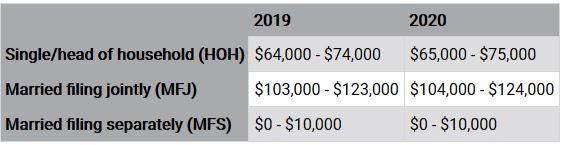
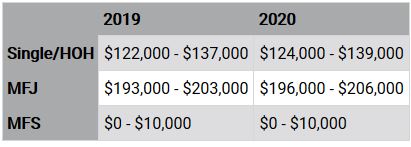
The combined annual limit on contributions to traditional and Roth IRAs is $6,000 in 2020 (the same as in 2019), with individuals age 50 and older able to contribute an additional $1,000. For individuals who are covered by a workplace retirement plan, the deduction for contributions to a traditional IRA phases out for the following modified adjusted gross income (MAGI) ranges:

Modified Adjusted Income Ranges

Note: The 2020 phaseout range is $196,000 – $206,000 (up from $193,000 – $203,000 in 2019) when the individual making the IRA contribution is not covered by a workplace retirement plan but is filing jointly with a spouse who is covered.

The modified adjusted gross income phaseout ranges for individuals to make contributions to a Roth IRA are:

Modified IRA Levels

Contact Frank if you would you like to schedule a no-obligation review of your retirement plan or financial plan and your tax plan for 2020.

Estate and gift tax

  • The annual gift tax exclusion for 2020 is $15,000, the same as in 2019.
  • The gift and estate tax basic exclusion amount for 2020 is $11,580,000, up from $11,400,000 in 2019.

Kiddie tax

Under the kiddie tax rules, unearned income above $2,200 in 2020 (the same as in 2019) is taxed using the trust and estate income tax brackets. The kiddie tax rules apply to: (1) those under age 18, (2) those age 18 whose earned income doesn’t exceed one-half of their support, and (3) those ages 19 to 23 who are full-time students and whose earned income doesn’t exceed one-half of their support.

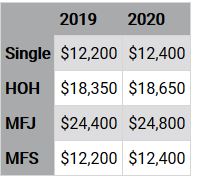
Standard deduction
Standard Deduction Table

The additional standard deduction amount for the blind or aged (age 65 or older) in 2020 is $1,650 (the same as in 2019) for single/HOH or $1,300 (the same as in 2019) for all other filing statuses. Special rules apply if you can be claimed as a dependent by another taxpayer.

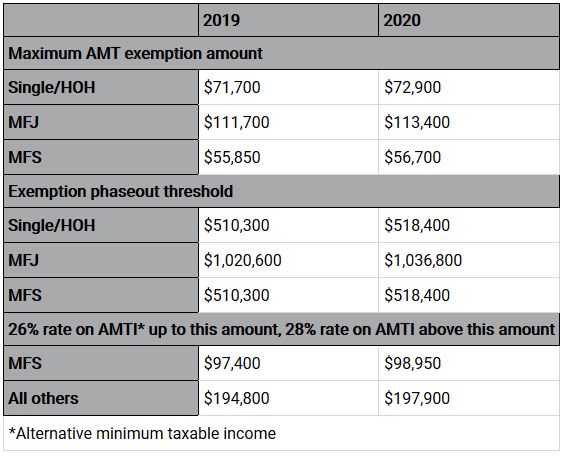
Alternative minimum tax (AMT)

Alternative Minimum Tax Table

Prepared by Broadridge Investor Communication Solutions, Inc. Copyright 2020.


Categories : Blog, Financial Services, Tax

What’s the Worst?

Posted by Frank McKinley on
 January 13, 2020

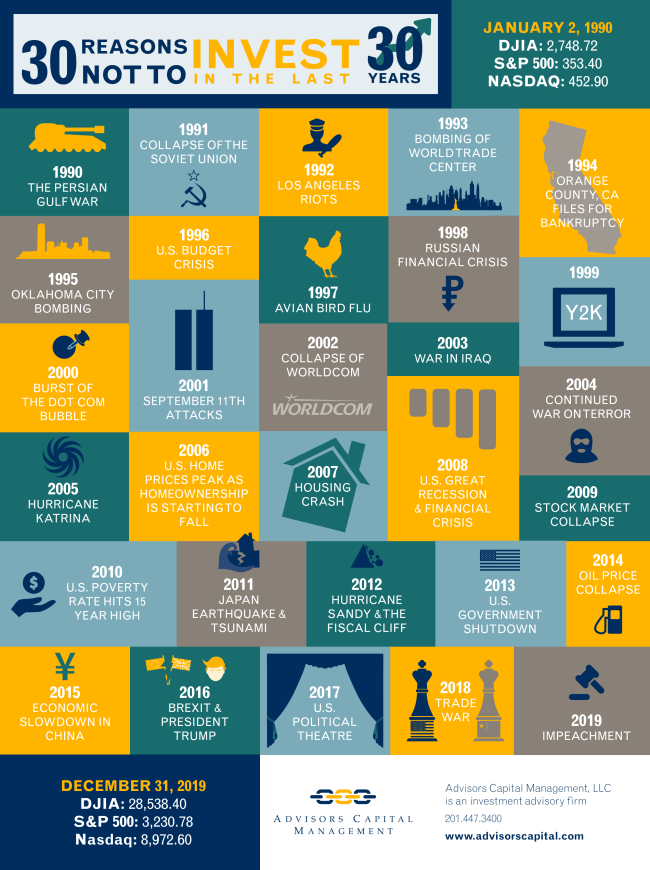
If you had let EVERY bit of BAD NEWS over the last 30 years keep you OUT of the market,
what would you have missed?

If you think THIS Iranian/Oil ‘crisis’, or threatening geopolitical situation is much different,
keep your head in the sand!

But should you realize that it too shall pass, that the market is simply stronger than the crisis Du Jour,
then PLEASE call me.

And we’ll get through it, plan for your financial future & retirement and your children’s’ education together!

DON’T MISS OUT ON THE HISTORY OF THE MARKET!
It is just too strong to ignore. Maintain perspective.

30 reasons not to invest over the past 30 years

Contact Frank if you would like to discuss your plan for your financial future & retirement
or your children’s’ education.


Categories : Blog, Financial Services, Investing, Investments, Retirement

Hindsight Is 2020: What Will You Do Differently This Year?

Posted by Frank McKinley on
 January 6, 2020

According to a recent survey, 76% of Americans reported having at least one financial regret. Over half of this group said it had to do with savings: 27% didn’t start saving for retirement soon enough, 19% didn’t contribute enough to an emergency fund, and 10% wish they had saved more for college.1

The saving conundrum

What’s preventing Americans from saving more? It’s a confluence of factors: stagnant wages over many years; the high cost of housing and college; meeting everyday expenses for food, utilities, and child care; and squeezing in unpredictable expenses for things like health care, car maintenance, and home repairs. When expenses are too high, people can’t save, and they often must borrow to buy what they need or want, which can lead to a never-ending cycle of debt.

People make financial decisions all the time, and sometimes these decisions don’t pan out as intended. Hindsight is 20/20, of course. Looking back, would you change anything?

Paying too much for housing

Are housing costs straining your budget? A standard lender guideline is to allocate no more than 28% of your income toward housing expenses, including your monthly mortgage payment, real estate taxes, homeowners insurance, and association dues (the “front-end” ratio), and no more than 36% of your income to cover all your monthly debt obligations, including housing expenses plus credit card bills, student loans, car loans, child support, and any other debt that shows on your credit report and requires monthly payments (the “back-end” ratio).

But just because a lender determines how much you can afford to borrow doesn’t mean you should. Why not set your ratios lower? Many things can throw off your ability to pay your monthly mortgage bill down the road — a job loss, one spouse giving up a job to take care of children, an unexpected medical expense, tuition bills for you or your child.

Potential solutions: To lower your housing costs, consider downsizing to a smaller home (or apartment) in the same area, researching and moving to a less expensive town or state, or renting out a portion of your current home. In addition, watch interest rates and refinance when the numbers make sense.

Paying too much for college

Outstanding student debt levels in the United States are off the charts, and it’s not just students who are borrowing. Approximately 15 million student loan borrowers are age 40 and older, and this demographic accounts for almost 40% of all student loan debt.2

Potential solutions: If you have a child in college now, ask the financial aid office about the availability of college-sponsored scholarships for current students, or consider having your child transfer to a less expensive school. If you have a child who is about to go to college, run the net price calculator that’s available on every college’s website to get an estimate of what your out-of-pocket costs will be at that school. Look at state universities or community colleges, which tend to be the most affordable. For any school, understand exactly how much you and/or your child will need to borrow — and what the monthly loan payment will be after graduation — before signing any loan documents.

Paying too much for your car

Automobile prices have grown rapidly in the last decade, and most drivers borrow to pay for their cars, with seven-year loans becoming more common.3 As a result, a growing number of buyers won’t pay off their auto loans before they trade in their cars for a new one, creating a cycle of debt.

Potential solutions: Consider buying a used car instead of a new one, be proactive with maintenance and tuneups, and try to use public transportation when possible to prolong the life of your car. As with your home, watch interest rates and refinance when the numbers make sense.

Keeping up with the Joneses

It’s easy to want what your friends, colleagues, or neighbors have — nice cars, trips, home amenities, memberships — and spend money (and possibly go into debt) to get them. That’s a mistake. Live within your means, not someone else’s.

Potential solutions: Aim to save at least 10% of your current income for retirement and try to set aside a few thousand dollars for an emergency fund (three to six months’ worth of monthly expenses is a common guideline). If you can’t do that, cut back on discretionary items, look for ways to lower your fixed costs, or explore ways to increase your current income.

1Bankrate’s Financial Security Index, May 2019
2Federal Reserve Bank of New York, Student Loan Data and Demographics, September 2018
3The Wall Street Journal, The Seven-Year Auto Loan: America’s Middle Class Can’t Afford Their Cars, October 1, 2019
Prepared by Broadridge Investor Communication Solutions, Inc. Copyright 2020.
Categories : Blog, Financial Services, Investments, Retirement

Should I sign up for an identity theft protection service?

Posted by Frank McKinley on
 December 23, 2019

Unfortunately, data breaches are now normal, everyday occurrences in our society. As a result, many companies are offering services to help you protect your personal information. If you want an extra layer of protection, an identity theft protection service is a good option. However, the term “identity theft protection service” can be misleading. The reality is that no one service can safeguard all of your personal information from identity theft. What most of these companies actually provide are identity theft monitoring and recovery services.

A monitoring service will watch for signs that an identity thief may be using your personal information. This typically includes tracking your credit reports for suspicious activity and alerting you whenever your personal information (e.g., Social Security number) is being used. The recovery portion of the service usually helps you deal with the consequences of identity theft. This often involves working with a case manager to help resolve identity theft issues (e.g., dealing with creditors or placing a freeze on your credit report). And depending on the level of protection you choose, the service may also provide reimbursement for out-of-pocket expenses directly associated with identity theft (e.g., postage, notary fees) and any funds stolen as a result of the identity theft (up to plan limits). Identity theft protection services usually charge a monthly fee. Entry-level plans that provide basic protection (e.g., Social Security number and credit alerts) can cost as little as $10 a month, while plans that offer more advanced features (e.g., investment account monitoring) will cost more.

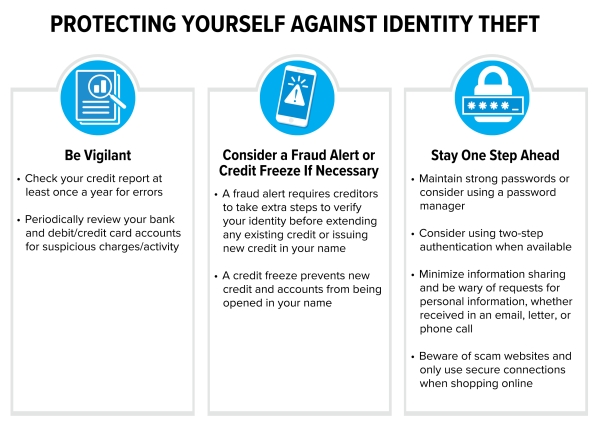
Keep in mind there are steps you can take on your own to help protect yourself against identity theft, such as:

  • Check your credit report at least once a year for errors
  • Periodically review your bank and debit/credit card accounts for suspicious charges/activity
  • Obtain a fraud alert or credit freeze if necessary
  • Have strong passwords, use two-step authentication, minimize information sharing, and be careful when shopping online

Protect yourself against identity theft


Categories : Blog, Financial Services

How to Give Like a Billionaire When You Don’t Have Billions to Give

Posted by Frank McKinley on
 December 16, 2019

Since Bill and Melinda Gates and Warren Buffett created the Giving Pledge in 2010, more than 200 of the world’s wealthiest individuals and couples have committed to giving the majority of their wealth to philanthropic or charitable causes.

Although the Giving Pledge only invites billionaires to join, “it is inspired by the example set by millions of people at all income levels who give generously — and often at great personal sacrifice — to make the world a better place.”*

You don’t have to be a billionaire to embrace the spirit of the Giving Pledge: When people come together to give, regardless of wealth, they can improve the lives of others.

Decide which causes matter most to you

Giving Pledge billionaires are a diverse group, coming from 23 countries and ranging in age from their 30s to their 90s. While they’re all dedicated to philanthropy, they support many different causes.

For example, Giving Pledge member Sara Blakely pledged to help empower women to prosper when she signed the pledge in 2013. She has since donated money to build homes for impoverished families and funded entrepreneurial programs for girls.

One of the newest signers of the Giving Pledge, Robert F. Smith, focuses on causes that support equality for African Americans. In May 2019, he told graduates of Morehouse College that he was paying off their student loans via a grant that is worth an estimated $40 million.

What causes are you passionate about? What are your values? Do you want to make an impact locally or globally? Aligning the causes you support with what’s meaningful to you can help deepen your long-term commitment to giving back.

Write down why you are giving

Director and producer George Lucas and his wife Mellody Hobson joined the Giving Pledge in 2010. Like other members, they wrote a statement explaining why they wanted to join and what they intended to accomplish.

“My pledge is to the process,” Lucas wrote; “as long as I have the resources at my disposal, I will seek to raise the bar for future generations of students of all ages. I am dedicating the majority of my wealth to improving education.”*

Lucas fulfilled part of this pledge by creating the George Lucas Educational Foundation to transform education through innovation.

Writing down your own intentions can help clarify your philanthropic goals and serve as a reminder of the impact your gift could have.

Inspire and learn by going public

The Giving Pledge hopes to “inspire conversations, discussions, and action, not only about how much, but also for what purposes/to what end.”*

Even if you normally prefer to keep your charitable work private, being open about the causes you support might help inspire others to give back.

Other perks of going public include being able to exchange ideas and lessons learned with others, and the opportunity to meet people in your community or around the world who share your commitment.

Connect generations through giving

A major goal of the Giving Pledge is to encourage long-term family giving that will help make the world a better place for generations to come.

Sharing your passion for helping others with your children or grandchildren can be especially rewarding. Setting family goals, choosing worthy causes, and volunteering together are ways that you can help unite generations and make philanthropy part of your family’s legacy.

*To learn more about the Giving Pledge and those who have signed it, visit givingpledge.org.
Categories : Blog, Contributions, Financial Services
← Previous Page
Next Page →

Recent Newsletters & Blogs

  • And you think you have it bad…
  • Winter, BRRR…
  • U.S. Elections Spark Global Financial Uncertainty
  • THE ELECTION IS HEATING UP!
  • 3 Mistakes Investors Make During Election Years

Archives


Categories

  • 529 Savings Plans
  • Blog
  • Bonds
  • College Savings
  • Contributions
  • Credit Card Debt
  • estate planning
  • financial planning
  • Financial Services
  • Insurance
  • Investing
  • Investments
  • IRA
  • Life Insurance
  • Long-term Care
  • Medicaid
  • Medicare
  • Newsletters
  • Paycheck Protection Program
  • rebate payments
  • Retirement
  • ROTH
  • Savings
  • Savings Goals
  • Security
  • Social Security
  • socially responsible investing
  • Stocks
  • Tax
  • The CARES Act
  • the SECURE ACT
  • unemployment benefits
  • Wills
Frankly Financial | Copyright © 2014. All Rights Reserved.
Site Designed by TriDelta Design Group